
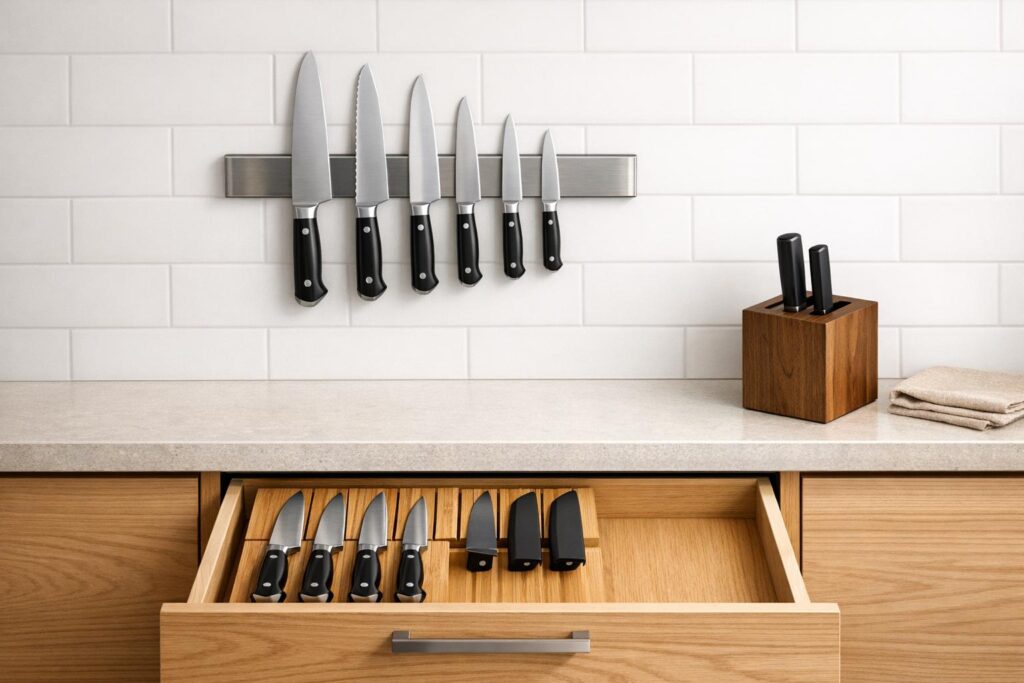
Keeping knives in a drawer without proper storage is unsafe and can ruin their edges. Over 350,000 injuries occur annually in the U.S. due to poorly stored knives, and improper storage dulls blades or causes chips. The solution? Use smart storage options that protect both you and your knives. Here’s a quick breakdown:
- Knife Blocks: Convenient but can trap bacteria in slots. Opt for blocks made from acacia, bamboo, or stainless steel for better hygiene.
- Magnetic Strips: Wall-mounted, space-saving, and easy to clean. Choose strips with strong neodymium magnets for secure knife storage.
- In-Drawer Organizers: Great for saving counter space. Bamboo and plastic options keep knives secure and organized.
- Blade Guards: Ideal for individual knives, especially during transport or when stored in drawers.
Key Tip: Always dry knives before storing to prevent rust and bacteria growth.
Choose the method that fits your kitchen space and safety needs, and follow proper storage practices to extend your knives’ lifespan and ensure a safer kitchen.
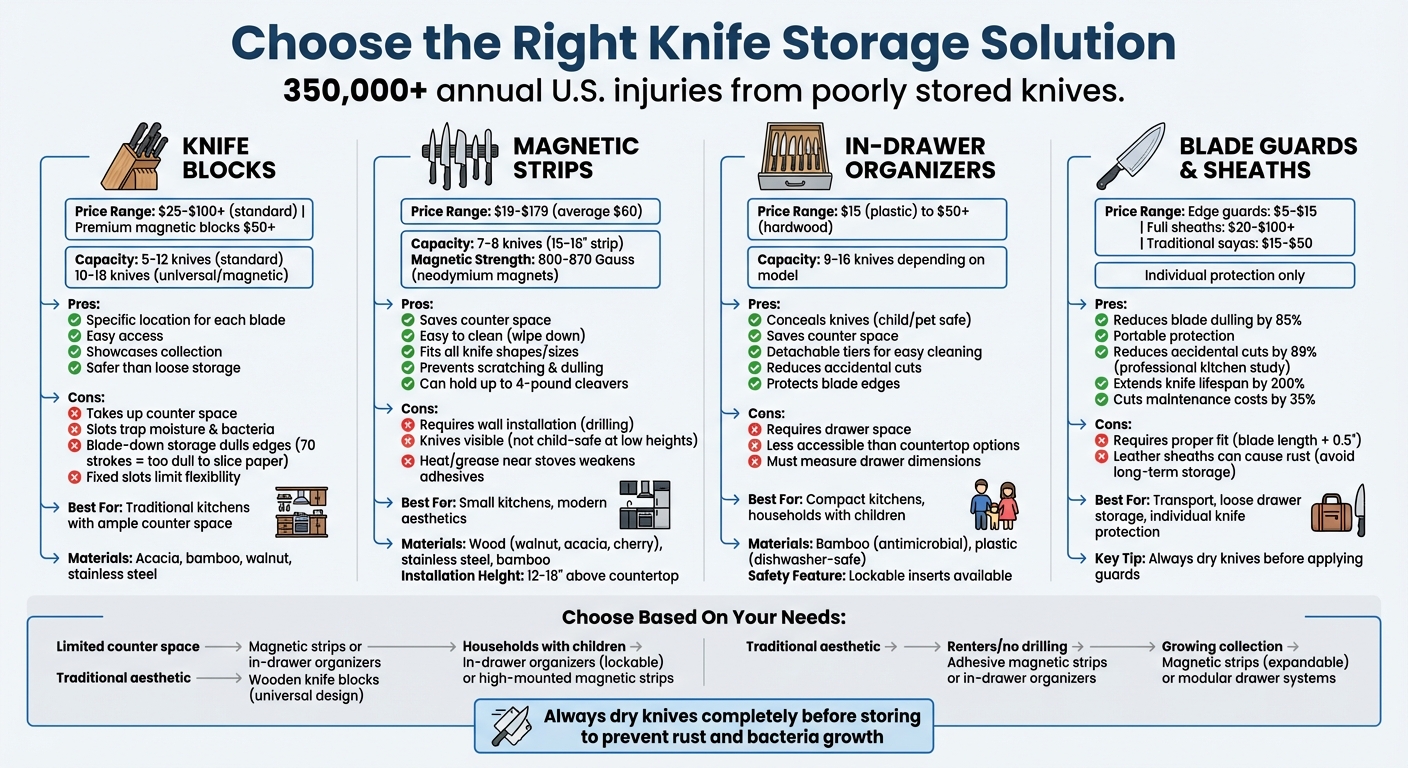
Knife Storage Methods Comparison: Pros, Cons, and Best Uses
Knife Storage Solutions for Every Kitchen
sbb-itb-663e316
Knife Blocks for Countertop Storage
Knife blocks are a practical way to keep your knives both accessible and safely stored. They strike a balance between convenience and protection, ensuring your knives are easy to grab while also extending their lifespan. Bobby Griggs, Vice President at Hammer Stahl Cutlery, captures their appeal:
The advantage of a knife block is it creates a specific storage area with, typically, a specific location for each blade. I think storage is about ease of access.
A well-crafted knife block not only organizes your kitchen but also showcases your knife collection. Its enclosed design offers a safer alternative to loose drawer storage, keeping sharp edges tucked away to prevent accidental cuts. With these benefits in mind, let’s explore the various designs that blend style with function.
The Downsides of Traditional Knife Blocks
While traditional knife blocks have their perks, they come with a few drawbacks. One major issue is hygiene. Deep slots can trap moisture and grime, creating a breeding ground for bacteria. Blade wear is another concern. Tests by America’s Test Kitchen revealed that repeatedly sliding a chef’s knife into a traditional block – blade-side down – dulls the edge significantly. After just 70 strokes, the knife was too dull to slice paper cleanly. To avoid this, storing knives on their spine is a better option for preserving sharpness.
Classic Wooden Knife Blocks
The material of a knife block plays a big role in its durability, look, and upkeep. Wooden blocks, made from materials like acacia and bamboo, resist moisture naturally and are budget-friendly. For a more premium feel, walnut offers an elegant finish and long-lasting durability. On the other hand, stainless steel blocks bring a sleek, modern vibe and resist bacteria, though they can be tougher on knife edges over time.
Standard wooden blocks are designed with pre-sized slots for specific knife sets, usually accommodating 5–12 knives. This creates a tidy, organized appearance but limits flexibility – adding a knife that doesn’t match the slot size can be a headache. Placement is also key. Wooden blocks should be kept away from sinks, as water exposure can warp or stain the wood. Always dry your knives thoroughly before storing them to prevent moisture buildup and potential microbial growth.
Slim and Space-Saving Designs
For smaller kitchens, universal knife blocks are a great alternative. These blocks ditch fixed slots in favor of flexible plastic or rubber rods, parallel slots, or even magnetic strips to fit a variety of blade shapes and sizes. They come in a range of price points, making them accessible to different budgets. One standout model is the Shenzhen Knives 20-Slot Universal Knife Block, which has earned over 4,300 five-star Amazon reviews for its ability to hold everything from paring knives to cleavers up to 3 inches wide.
Slanted knife blocks offer another space-saving option. They make it easier to access and remove knives compared to vertical blocks, though they do require more counter depth. Before purchasing, check the vertical clearance under your cabinets to ensure you can comfortably remove your longest knives. Some newer designs, like the Oou Universal Knife Block, even feature removable components that are dishwasher-safe, making cleanup a breeze.
For those seeking a premium option, the Schmidt Bros. Acacia Downtown Magnetic Knife Block combines the best of traditional and modern designs. It uses magnetic technology to hold up to 18 knives securely, eliminating the need for deep slots that can trap dirt and moisture. This hybrid approach addresses both hygiene concerns and the limitations of standard wooden blocks.
Magnetic Strips for Wall-Mounted Storage
Magnetic strips offer a sleek, space-saving way to store knives while keeping them visible and within arm’s reach. Mounted on the wall, they free up counter space and avoid the moisture issues that can plague enclosed blocks. Plus, they’re easy to clean – just wipe them down with a damp cloth. Unlike traditional knife blocks, magnetic strips can hold knives of all shapes and sizes, from delicate paring knives to hefty cleavers, and even kitchen shears.
When tested across 27 models, magnetic knife holders ranged in price from $19 to $179, with an average cost of $60. Most strips are 15 to 20 inches long, making them a good fit for typical home knife collections. Thanks to high-strength neodymium magnets, these strips can securely hold even heavy-duty knives, like a 15.5-ounce meat cleaver or a 4-pound cleaver, without slipping. Another benefit? Storing knives this way helps prevent scratching and dulling, which can happen with other storage methods.
Selecting the Right Magnetic Strip
The material of the magnetic strip plays a big role in both functionality and style. Wood-surfaced strips, often made of walnut, acacia, or cherry, are gentle on knife edges and add a warm, classic look to your kitchen. However, they do require occasional maintenance, like oiling with food-safe mineral oil to keep the wood from drying out. Stainless steel strips, on the other hand, bring a modern, polished feel and are easier to sanitize. Just be cautious, as they can scratch or chip blades if not used carefully. Bamboo strips are another option, offering a naturally antimicrobial surface and eco-friendly appeal, though they may have a lower weight capacity.
Magnetic strength is crucial, especially if you plan to store heavier knives. Strips with neodymium magnets typically have a strength of 800 to 870 Gauss, which is strong enough to hold even the heaviest blades securely. Avoid strips with weaker magnets (200 to 300 Gauss), as they may struggle with heavier or larger knives. For consistent performance, choose strips with continuous magnets rather than individual magnetic pockets, which can create "dead zones" where smaller knives might not stick. Also, ensure the strip is at least 0.75 to 1.5 inches thick to allow enough knuckle clearance when grabbing your knives. For example, the 360KnifeBlock BAR, rated a top pick by America’s Test Kitchen in July 2025, provides 1.5 inches of clearance and includes a built-in spirit level for precise installation.
Installation and Safety Guidelines
Most magnetic strips require a permanent installation, which involves drilling into the wall. If you’re mounting on drywall, use wall anchors to ensure the strip can support the weight of heavy knives. For tile backsplashes, where drilling could cause cracks, heavy-duty double-sided tape rated for at least 20 kg per 4 inches is a solid alternative. Before applying the adhesive, clean the surface with isopropyl alcohol and let the adhesive cure for the time recommended by the manufacturer, usually about 24 hours, before hanging your knives.
Placement is key for both safety and convenience. Avoid mounting the strip above a sink, where knives could fall into the basin, or near stoves, where heat and grease could weaken adhesives or coat the blades. A good height is 12 to 18 inches above the countertop – high enough to keep knives out of children’s reach but still easy to access. Using a spirit level during installation ensures the strip is perfectly horizontal, so your knives hang straight.
To keep your blades in top shape, always attach knives spine-first. Gently place the spine of the knife against the magnet until it clicks into place, then rotate it flat. When removing a knife, tilt it using the spine as a pivot to avoid damaging the blade. Geoff Feder, owner of Feder Knives, offers this advice:
It’s safer to store the knives point-down on a magnetic block, where the bolster of the knife rests on the top of the ledge of the strip.
This method ensures knives stay securely in place while also protecting their edges, making it a smart choice for both safety and blade longevity.
In-Drawer Knife Organizers and Trays
If your kitchen counter space is limited, in-drawer knife organizers provide a smart way to keep knives concealed, protected, and sharp – all while staying out of reach of children and pets. Unlike countertop knife blocks, which can trap moisture and encourage bacteria growth, these in-drawer solutions are designed with detachable tiers and removable trays, making them much easier to clean. They also reduce the risk of accidental cuts and blade damage by keeping knives securely in place.
Before purchasing, measure your drawer dimensions to ensure the organizer fits properly. These organizers come in a range of styles and prices: plastic models start at just $15, bamboo versions typically cost between $25 and $40, and premium hardwood options start at $50. As Henry Liu, President and CEO of Cangshan Cutlery Company, explains:
for compact kitchens, an in-drawer organizer or magnetic knife bar are also great options.
Bamboo and Plastic Organizers
Bamboo organizers are a popular choice for their knife-friendly surface and natural antimicrobial properties, making them ideal for high-quality blades. For example, the Utoplike Bamboo Organizer can store up to 16 knives, plus a sharpening steel, and even includes slots for larger steak knives. For smaller kitchens, the Joseph Joseph DrawerStore offers a clever 2-tier design that users often call a "game-changer", as it holds up to 9 knives while taking up minimal drawer space. To keep bamboo organizers in good condition, ensure knives are completely dry before storing to prevent microbial growth.
Plastic organizers, on the other hand, are easier to maintain since many are dishwasher-safe and come with removable trays for quick cleaning. The OXO Good Grips Compact Organizer is a standout option, thanks to its removable tray that makes cleaning crumbs and dust a breeze. For those on a budget, the Madesmart Large Knife Mat offers practical storage for $13.55 to $17.99. When shopping for plastic organizers, look for designs with non-slip feet or squared corners to keep them stable and prevent jamming when opening or closing the drawer.
If safety is a top concern, especially in households with children, lockable drawer inserts are worth considering.
Lockable Drawer Inserts
Lockable drawer inserts are a secure storage solution that fits standard kitchen drawers, keeping sharp knives completely out of sight – a safer option than countertop blocks or magnetic strips. These inserts provide peace of mind by adding an extra layer of protection in homes with kids. When using any drawer organizer, always store knives with the cutting edge facing down or resting on the spine to avoid dulling the blades and to minimize the risk of accidental cuts. For carbon steel knives, applying a thin coat of food-grade mineral oil before storage creates a moisture barrier to help prevent rust.
Blade Guards and Sheaths for Individual Knives
While bulk storage options secure an entire knife collection, blade guards and sheaths focus on protecting individual knives. These tools are especially useful for loose or transportable knives, creating a physical barrier to shield the blade – and anyone who might come into contact with it. In the U.S., kitchen knife accidents result in nearly 330,000 serious injuries annually, making proper blade protection a critical safety measure. Additionally, using guards or sheaths can reduce blade dulling by up to 85% compared to tossing knives unprotected into a drawer. They also work well alongside storage solutions like countertop blocks, wall-mounted racks, and in-drawer organizers by offering added protection during storage or transport.
Blade guards generally fall into three main types: edge guards ($5–$15), full sheaths ($20–$100+), and traditional sayas ($15–$50) [36,37]. Bobby Griggs, Vice President at Hammer Stahl Cutlery, advises choosing felt-lined sheaths to prevent scratches on the blade’s finish, particularly for high-end knives. For Western-style chef’s knives with angled bolsters, guards with diagonal cutouts provide full coverage.
To ensure proper use, always dry knives completely before applying a guard to avoid rusting [28,35]. Avoid storing knives in leather sheaths for extended periods, as the tannins and acids in leather can damage the blade and cause rust. A guard should fit snugly, covering the entire blade length plus an extra 0.5 inches, with no exposed edges at the tip or heel [6,37].
For households with children, blade guards add an extra layer of safety, even when knives are kept in lockable drawers. A six-month study in professional kitchens showed that using blade protection reduced accidental cuts by 89%. To further enhance safety, store sheathed knives on high shelves or in lockable cabinets to prevent access by children [4,35].
As James Peterson, Professional Chef and Culinary Instructor, puts it:
A quality knife guard is as essential to knife maintenance as proper sharpening techniques.
Research also highlights that proper blade protection can extend a knife’s lifespan by up to 200% through better edge preservation, while also cutting maintenance costs by 35% in professional kitchens. Whether at home or on the move, blade guards and sheaths offer critical protection for both knives and hands.
Choosing the Right Storage Solution for Your Kitchen
Evaluating Your Space and Requirements
Start by measuring your available space. Traditional knife blocks take up valuable counter space, while magnetic strips can be mounted on walls, keeping your counters clear and organized. If counter space is limited, wall-mounted magnetic strips (typically 15–16 inches, holding 7–8 knives) or in-drawer organizers are great alternatives. For renters, double-sided magnetic strips or adhesive-backed options offer a no-drill solution. Households with children or pets should prioritize safety by choosing in-drawer organizers or high-mounted wall options to keep knives out of reach.
Bobby Griggs highlights that effective knife storage should balance safety with accessibility. Hygiene is another key factor – ensure proper airflow and avoid placing storage near sinks to prevent moisture buildup, which can lead to warping or microbial growth. Magnetic strips and slotless knife blocks are easier to clean and promote better airflow compared to traditional slotted blocks.
Once you’ve considered your space and safety needs, think about how your storage solution can adapt as your knife collection expands.
Planning for Your Growing Knife Collection
To future-proof your storage, think beyond standard slotted blocks. These blocks often have a fixed number of pre-sized slots, which might not accommodate new or differently shaped knives. Magnetic strips offer unmatched flexibility – they can be expanded horizontally or vertically to fit more knives as your collection grows. Some magnetic knife blocks can hold 10–14 knives while taking up less space than traditional slotted blocks.
Modular systems are another adaptable option. Many in-drawer organizers come in sets of 3, 5, or 9 pieces, allowing you to add components as needed. For example, the Made In 9-Piece Organizer ($99), praised by Bon Appétit editors, features grippy feet and magnetic side attachments for easy expansion. If your knives are a mix of shapes and sizes, universal blocks with flexible rods or magnetic stands are better suited than pre-sized slots.
Henry Liu, Founder and CEO of Cangshan Cutlery Company, offers practical advice:
for compact kitchens, an in-drawer organizer or magnetic knife bar are also great options.
Conclusion
Picking the right knife storage option is key for ensuring safety, cleanliness, and keeping your blades in top shape. A well-thought-out storage solution not only protects your investment but also helps avoid accidents and promotes better hygiene. As Henry Liu points out, having an organized storage system is much safer and extends the life of your knives.
The best storage option often comes down to your kitchen layout and specific safety requirements. Magnetic strips are perfect for smaller kitchens where counter space is at a premium. On the other hand, in-drawer organizers are a smart choice for households with children, as they keep sharp edges tucked away safely. If you prefer a classic look and easy access, traditional knife blocks might be your go-to, but they do require extra cleaning since studies, like one from NSF International, rank them among the germiest items in the kitchen.
No matter which storage solution you choose, always make sure your knives are completely dry before putting them away – this helps prevent rust and microbial growth. For magnetic strips, roll the knives onto the magnet spine-first to avoid damaging the blade. If you’re using a slotted knife block, store knives with the spine facing down. Research shows that this method helps maintain blade sharpness, while storing them blade-down can dull edges faster.
Ultimately, the best storage choice is one that balances safety, accessibility, and space efficiency. Consider your kitchen’s layout and your long-term needs to find a solution that keeps your knives sharp and your kitchen safe.
FAQs
How do I safely clean a knife block or drawer organizer?
To clean your knife block or drawer organizer safely and effectively, start by carefully removing all the knives to avoid any accidents. Shake out any debris trapped inside, then use a small brush to scrub the slots thoroughly. For the exterior, wipe it down with hot, soapy water, and make sure to dry it completely. Avoid soaking wooden parts or putting the organizer in the dishwasher, as water can warp or damage the material. Regular cleaning not only keeps things hygienic but also helps your storage last longer.
What magnet strength do I need for a knife strip?
Magnetic knife strips rely on powerful magnets to keep knives securely in place. Although the exact strength of the magnets isn’t always specified, the top-rated option tested in 2026 stood out for having the strongest magnetic field among the reviewed choices. For the best results, choose a highly-rated knife strip with a dependable magnetic hold to ensure both safety and convenience.
What’s the safest knife storage option with kids at home?
The best way to keep knives safe when you have kids at home is by using locked cabinets, lockable drawer inserts, or knife guards. These methods ensure sharp tools stay out of reach, minimizing the chances of accidents. Always double-check that your storage setup is secure and completely inaccessible to little ones.