
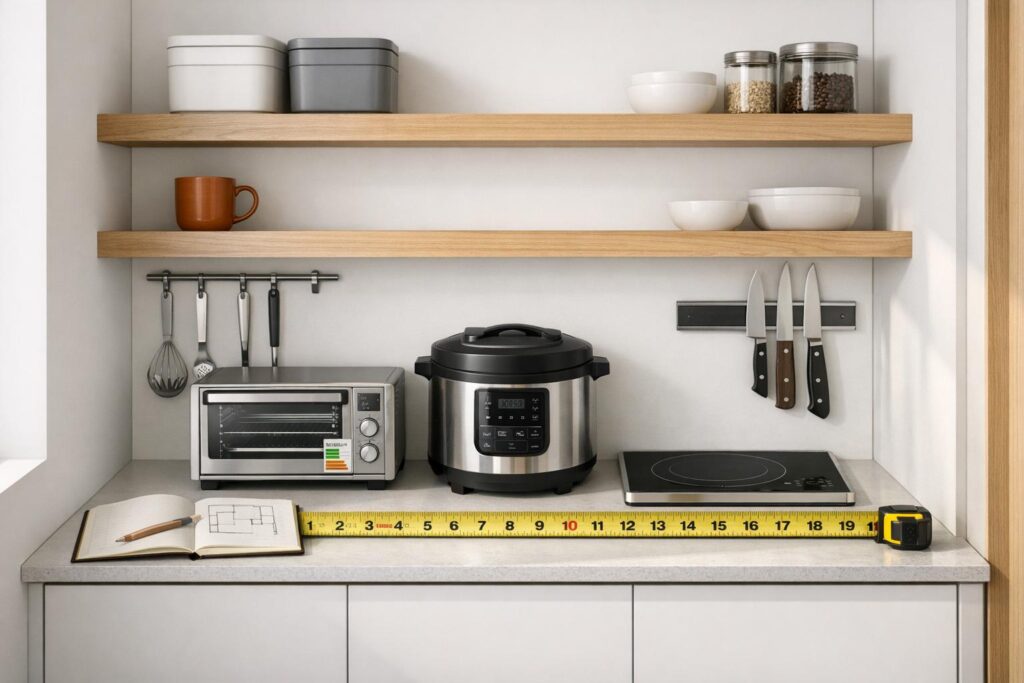
When your kitchen is short on space, every appliance needs to work harder without taking up too much room. The key? Focus on compact, multi-functional appliances that deliver maximum utility while saving space. Here’s a quick breakdown:
- Measure First: Know your kitchen’s dimensions, including countertops, cabinets, and doorways, to ensure appliances fit perfectly.
- Multi-Functional Gadgets: Look for tools that combine functions, like an air fryer toaster oven or a multi-cooker, to replace multiple devices.
- Compact Cooking Options: Choose slim ranges, portable induction cooktops, or over-the-range microwaves to free up counter space.
- Small Refrigeration Units: Opt for top-freezer refrigerators or mini-fridges for efficient cooling without wasting space.
- Smart Storage: Use vertical shelves, appliance garages, or rolling carts to keep gadgets accessible but out of the way.
With the right appliances and thoughtful organization, even the smallest kitchens can be practical and efficient.
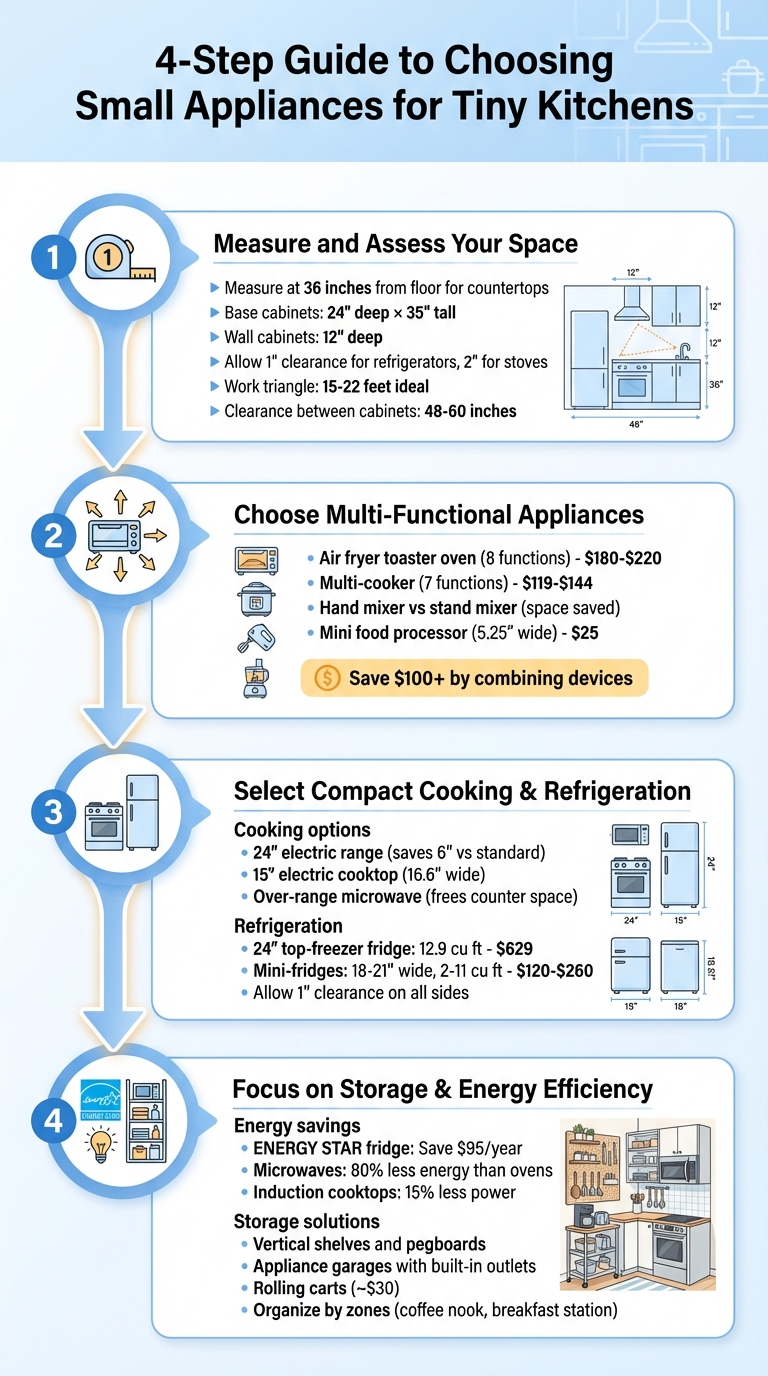
4-Step Guide to Choosing Small Appliances for Tiny Kitchens
Small Appliances for Small Spaces | How to Shop for a Small Home
sbb-itb-663e316
Step 1: Measure and Assess Your Space
Before diving into appliance shopping, grab a tape measure and get precise. Start by measuring every dimension of your kitchen, noting the length of each wall and the height of vertical spaces. For countertops, measure at 36 inches from the floor, which is the standard height. Don’t forget to check vertical clearances to ensure there’s enough room for appliances. These measurements will help you figure out what fits where. Pay special attention to countertops, cabinets, and high-traffic areas.
Here’s a great tip from Cassie Womack:
"Even a fraction of an inch can make a big difference. It’s easy to forget about hinges or overlook seemingly small lips and ledges".
When walls or spaces aren’t perfectly square, always use the narrowest dimension. Measure every side and stick with the smallest number to avoid surprises. For cabinets, measure from one wall to the other and add the case width (often listed on the appliance) for an accurate fit.
Measure Countertop and Cabinet Space
Here’s what you need to know about standard measurements:
- Base cabinets are typically 24 inches deep and 35 inches tall.
- Wall cabinets are usually 12 inches deep.
- Compact refrigerators and dishwashers are about 30 inches and 18 inches wide, respectively.
Allow for some breathing room – 1 inch of clearance for refrigerators and 2 inches for stoves. Don’t forget to check if the manufacturer’s specs include handles and door swings. Also, measure doorways and hallways to ensure the appliance can actually make it into your kitchen.
Identify High-Traffic Zones
Your kitchen’s work triangle – the path connecting the sink, refrigerator, and range – is where most of the action happens. Keep this area clear and functional, with a total distance between 12 and 26 feet, though 15 to 22 feet is ideal. Architect Bud Dietrich emphasizes the importance of planning for specific tasks:
"Instead of shoehorning these items into kitchen cabinets as an afterthought or simply loading the countertops with them, I anticipate them by proposing kitchen designs that have established zones for small-appliance storage and room for their associated tasks".
For comfortable movement, leave 48 to 60 inches of clearance between facing cabinets so two people can pass easily. Place your refrigerator at the end of a counter run, ensuring at least 18 inches of counter space on the handle side for convenience. If you’re a fan of morning rituals, set up a 6-foot breakfast station for toasters, coffee makers, and other essentials, away from the main cooking area to avoid congestion during meal prep.
Step 2: Choose Multi-Functional Appliances
With your kitchen measurements in hand (see Step 1), it’s time to pick appliances that pack a punch without hogging space. In a small kitchen, every gadget has to pull double (or triple) duty. The goal? Maximize functionality while keeping clutter at bay.
Perry Santanachote from Consumer Reports sums it up perfectly:
"The trick is relying on gadgets that earn their keep while occupying the least amount of real estate on the counter".
These space-saving appliances don’t just clear up your countertops – they can also save you money. For example, opting for a high-quality air fryer toaster oven instead of buying separate devices can save over $100. Plus, you’ll have more room to actually cook.
Examples of Multi-Functional Appliances
Air fryer toaster ovens are a must-have for small kitchens. Take the Ninja Flip, which costs between $180 and $220. It offers eight functions, including air frying, roasting, baking, and dehydrating, all while taking up minimal space thanks to its vertical flip design. Chef Katie Briggs, founder of West Philly Bunny Hop, swears by hers:
"I disconnected my gas stove because it was more expensive to run, and now I do everything in my toaster oven. I boil water in it. I toast, I reheat, I bake".
Multi-cookers like the Instant Pot DUO60 (priced around $119–$144) combine seven functions, including pressure cooking, slow cooking, steaming, and sautéing. This compact unit can replace multiple appliances, and the 3-quart version is even smaller, saving precious counter space.
For smaller tasks, hand tools with multiple attachments are game-changers. A hand mixer like the Breville Handy Mix Scraper can do the job of a bulky stand mixer but fits neatly in a drawer. Immersion blenders with attachments for whisking or frothing can replace several gadgets. Coffee lovers might appreciate the Nespresso Essenza Mini, which measures just 6–7 inches wide and performs exceptionally well, according to Consumer Reports.
Mini versions of standard appliances are another smart choice. A Hamilton Beach 3-cup food processor ($25) is only 5.25 inches wide but handles tasks like chopping herbs or garlic with ease. The Dash 2-Quart Compact Air Fryer ($50) is perfect for one or two people. Even a Crock-Pot Mini Round Slow Cooker (1.5 quarts) costs just $15 and works as well as larger models for small households.
What to Look for When Choosing
When picking appliances, details matter.
- Dimensions: Don’t just check the footprint – consider height too. For example, the Vitamix 5200 blender stands 20.5 inches tall, which might not fit under standard cabinets. Measure your space before buying anything tall.
- Storage-friendly designs: Look for appliances with collapsible or slim profiles. The T-magitic foldable electric kettle ($30–$37) boils water in minutes and folds down for easy storage. Some toasters are less than 4 inches wide, making them easy to tuck away.
- Capacity: Even compact appliances can be surprisingly roomy. Many small toaster ovens can handle a 12-inch pizza. The Panasonic FlashXpress is one example – it’s highly rated for even toasting and has one of the smallest footprints in its category.
- Reliability: Check brand ratings. For instance, Breville gets top marks for reliability in toaster ovens, while the Cuisinart TOB-135N is praised for ease of cleaning and excellent batch toasting. Consumer Reports’ survey of over 27,000 toaster ovens highlights significant differences in reliability between brands.
- Ease of maintenance: Multi-functional appliances often have more parts, so look for dishwasher-safe components and easy-to-clean surfaces. If cleaning becomes a chore, that “convenient” gadget might end up collecting dust.
Step 3: Select Compact Cooking and Refrigeration Options
Compact Cooking Appliances
When designing a tiny kitchen, choosing compact cooking appliances is a must. For small spaces, the standard width for ranges and refrigerators is 24 inches – perfectly suited for tight layouts. With the measurements you’ve already taken, these space-saving appliances will fit seamlessly into your design while complementing multi-functional gadgets.
Take the Whirlpool WFE500M4HS 24-inch electric range ($1,528.99), for instance. This model includes a full oven and stovetop in a slim 24-inch frame, saving 6 inches compared to traditional ranges. For even smaller setups, Whirlpool’s 15-inch electric cooktop offers a sleek solution at just 16.6 inches wide. It’s so compact that it can be stored in a drawer when not in use.
Another clever option is an over-the-range microwave, which not only heats your food but also provides ventilation, freeing up counter space. Compact countertop microwaves like the Danby DDMW007501G1 (10x18x13 inches) and the LG NeoChef 0.9 Cu. Ft. Microwave are excellent examples of efficient, space-conscious designs. The LG model, in particular, is known for its even heating despite its small size.
Portable induction cooktops are another standout. They’re quick to heat, offer precise temperature control, and can be stored easily when not in use – some even double as extra workspace for added convenience.
Small Refrigeration Units
Once your cooking area is sorted, it’s time to focus on refrigeration. Like ranges, compact refrigerators are often 24 inches wide, making them a perfect fit for small kitchens. The Whirlpool 24-inch Top-Freezer Refrigerator (WRT313CZLB), priced at $628.99, provides 12.9 cubic feet of storage and is a reliable, space-efficient option. Top-freezer models are generally the most practical choice for small kitchens – they’re affordable, dependable, and make the most of limited space.
Nish Suvarnakar of Consumer Reports highlights the growing popularity of these smaller models:
"These smaller models gained more visibility in retail stores in recent years, likely due to changing consumer preferences from the many millennials entering the appliance market".
When selecting a refrigerator, proper ventilation is crucial. Allow for at least 1 inch of clearance on each side, 1 inch at the top, and at least 1 inch behind the unit to ensure airflow. Also, consider the door swing – French-door or side-by-side models are ideal for narrow galley kitchens since their doors require less clearance to open fully.
Energy efficiency is another factor to keep in mind. Over a 10-year lifespan, a refrigerator can add $50 to $60 per year to your energy bill. Look for the ENERGY STAR label and compare EnergyGuide labels to estimate annual operating costs.
For extremely tight spaces, mini-fridges are a practical alternative. These models range from 18 to 21 inches in width, cost between $120 and $260, and offer 2–11 cubic feet of storage. However, it’s important to note that mini-fridges often fall short in freezer performance and may lack features like adjustable shelving or door bins.
Step 4: Focus on Storage and Energy Efficiency
Once you’ve chosen compact appliances, it’s time to think about energy efficiency and smart storage strategies for your small kitchen.
Energy Efficiency Ratings and Savings
Energy-efficient appliances are not just good for the environment – they can also save you money. Look for the ENERGY STAR label, which signifies that a product meets the U.S. EPA’s energy-efficiency standards. These appliances often outperform federal minimum requirements, offering long-term savings.
For instance, if you replace a refrigerator that’s over 15 years old with an ENERGY STAR model, you could save about $95 annually on energy bills, adding up to $150 to $160 over a typical 12-year lifespan. ENERGY STAR refrigerators are around 9% more efficient than standard models, and certified wine and beverage coolers can be up to 20% more efficient.
To compare operating costs, check the EnergyGuide label. Think of it this way: every appliance has two costs – the upfront price and the ongoing energy expenses over its lifetime, which can span 10 to 20 years.
Some appliances are naturally more energy-efficient too. Microwaves, for example, use up to 80% less energy than a conventional oven or electric range. Induction cooktops consume about 15% less power than traditional electric coil models, and convection ovens are about 20% more efficient than standard ovens. These compact options are perfect for small kitchens, offering the same functionality as their larger counterparts.
When selecting a refrigerator, models with a top-mounted freezer generally use the least energy compared to bottom-freezer or side-by-side designs. Also, check the door seals – airtight seals prevent energy loss, ensuring your appliance doesn’t have to work overtime.
With energy efficiency covered, let’s move on to making the most of your storage space.
Smart Storage Solutions
In a small kitchen, storage is everything. It’s not just about tidiness – it’s about making your space work smarter. Melanie Summers, an organization expert, puts it this way:
"You’ve got two priorities here: concealment and convenience. The trick is to store small appliances in the zones where they get used."
Vertical storage is a game-changer. Use wall-mounted shelves, wire racks, pegboards, or floating corner shelves to transform unused wall space into functional storage. For items you don’t use daily, like bread makers or juicers, store them on high shelves or even in a nearby room. Save your lower cabinets for appliances you use more often.
Appliance garages are another clever solution. These countertop-level cabinets with roll-up or flip-up doors provide a clutter-free look while keeping frequently used items like toasters and coffee makers within reach. Kitchen design expert Thomas Borcherding explains:
"Electrical outlets are situated inside of appliance garages so there’s no need to relocate the appliance once the door is opened."
For heavier appliances like stand mixers, consider installing mixer lifts in base cabinets. These mechanical lifts make it easy to access and store bulky items without straining your back. Swing-out corner shelves and pull-out wire drawers also help you make the most of deep or hard-to-reach cabinets.
Mobile storage offers flexibility for tight spaces. Rolling kitchen carts can hold bulky appliances like Instant Pots or air fryers and cost around $30. For a budget-friendly alternative, rolling plant stands (under $9) can help you move heavy items into a closet or corner when not in use. Even an IKEA Billy Bookcase (about $39) can be repurposed as a DIY appliance pantry.
Other tips include placing your toaster or coffee maker on a small cutting board so you can slide it in and out from under upper cabinets easily. Use shelf risers in tall cabinets to stack smaller appliances and maximize vertical space. If your microwave takes up counter space, add a "straddle rack" above it to create an extra shelf for lightweight items like a toaster.
Finally, organize appliances by zones. For example, create a "coffee nook" or "breakfast station" where you group your coffee maker, toaster, and related accessories like filters or mugs. Clear acrylic bins are great for storing small attachments like blender blades or mixer beaters, so they don’t disappear into the depths of your cabinets.
Conclusion: Create a Functional Small Kitchen
Even the smallest kitchens can become efficient and enjoyable spaces with smart planning and thoughtful choices. For example, a 37-square-foot kitchen can be transformed into a practical cooking area by focusing on precise measurements, multi-purpose tools, and energy-saving appliances.
Investing in appliances that serve multiple roles is a game-changer. Think about how an Instant Pot can replace several gadgets, or how a 9-in-1 air fryer can handle roasting, baking, reheating, and dehydrating – all while freeing up precious counter space. As chef and educator Maika Frederic-Liebman explains:
"In a busy kitchen, the right small appliance can feel like having an extra set of hands".
Compact, high-performance appliances are another must. These options save space without compromising functionality. But don’t forget to double-check dimensions – some high-powered blenders, for instance, might not fit under standard upper cabinets.
Induction cooktops are another smart choice for small kitchens. They heat up and cool down quickly, use less energy than traditional electric coils, and help lower utility bills.
Lastly, keep countertops clear by storing less-used items vertically or in hidden spaces. This approach not only maximizes your workspace but also reinforces the importance of organized storage. With these strategies, even the tiniest kitchen can become a space where cooking feels easy and enjoyable.
FAQs
What appliances should I buy first for a tiny kitchen?
Maximize your small kitchen by opting for space-saving, multifunctional appliances. Look for versatile devices like an air fryer or multi-cooker, which can handle several cooking tasks in one compact unit. For everyday needs, consider smaller tools like a mini blender or toaster oven – they’re perfect for saving counter space while staying practical. Choosing appliances that serve multiple purposes helps streamline your cooking while keeping your kitchen clutter-free.
How do I know an appliance will fit with door swing and clearance?
When measuring the space for your appliance, take precise measurements of the width, height, and depth. Don’t forget to account for the clearance needed for the door to open fully. Look out for features like offset hinges or doors designed to swing completely clear of the opening. For larger appliances, it’s smart to measure at several points to account for uneven surfaces. Also, make sure to leave enough extra space for proper ventilation and smooth door operation, avoiding any potential obstructions.
Which compact appliances save the most energy day to day?
Energy-saving small appliances, such as LED lights, modern refrigerators, and smart cooktops, are excellent choices for reducing daily energy use. These devices are designed to consume less power while maintaining high performance, making them perfect for smaller kitchen spaces.