
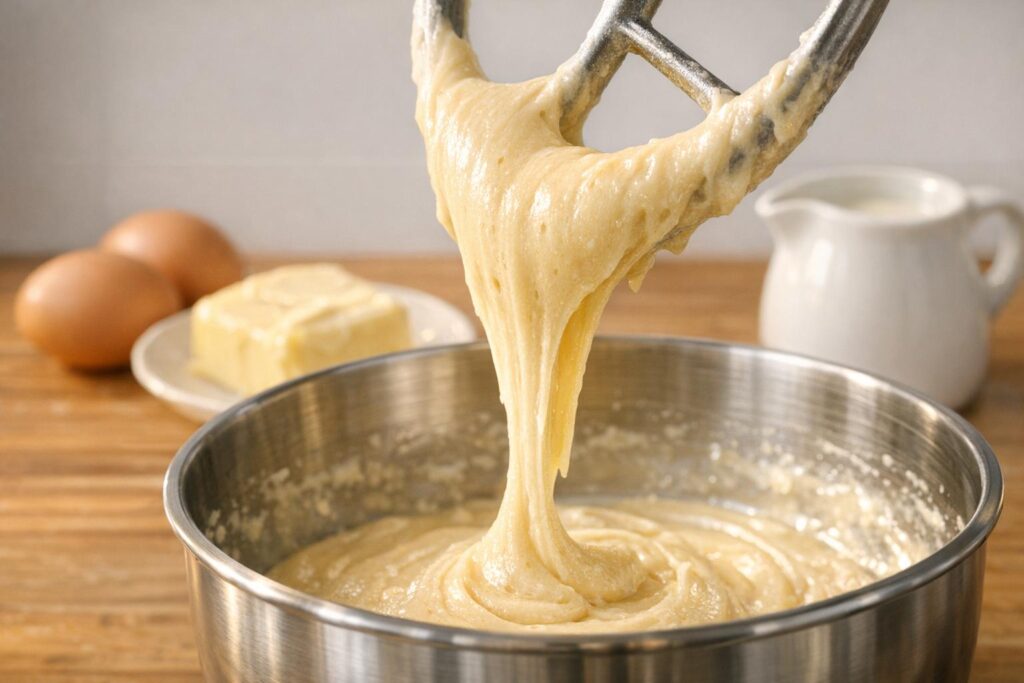
When baking, using room temperature ingredients – like butter, eggs, and dairy – can make a huge difference. These ingredients blend more smoothly, trap air effectively, and create better textures. Cold ingredients, on the other hand, can cause lumpy batters, dense cakes, and uneven baking results.
Key Points:
- Better Mixing: Room temperature ingredients combine seamlessly, preventing curdling or separation.
- Improved Texture: Trapped air in softened butter and whipped eggs leads to lighter, fluffier baked goods.
- Even Baking: Uniform ingredient temperature ensures consistent results, avoiding burnt edges or raw centers.
To quickly bring items to room temperature, submerge eggs in warm water or cut butter into small pieces. These simple adjustments can elevate your baking results.
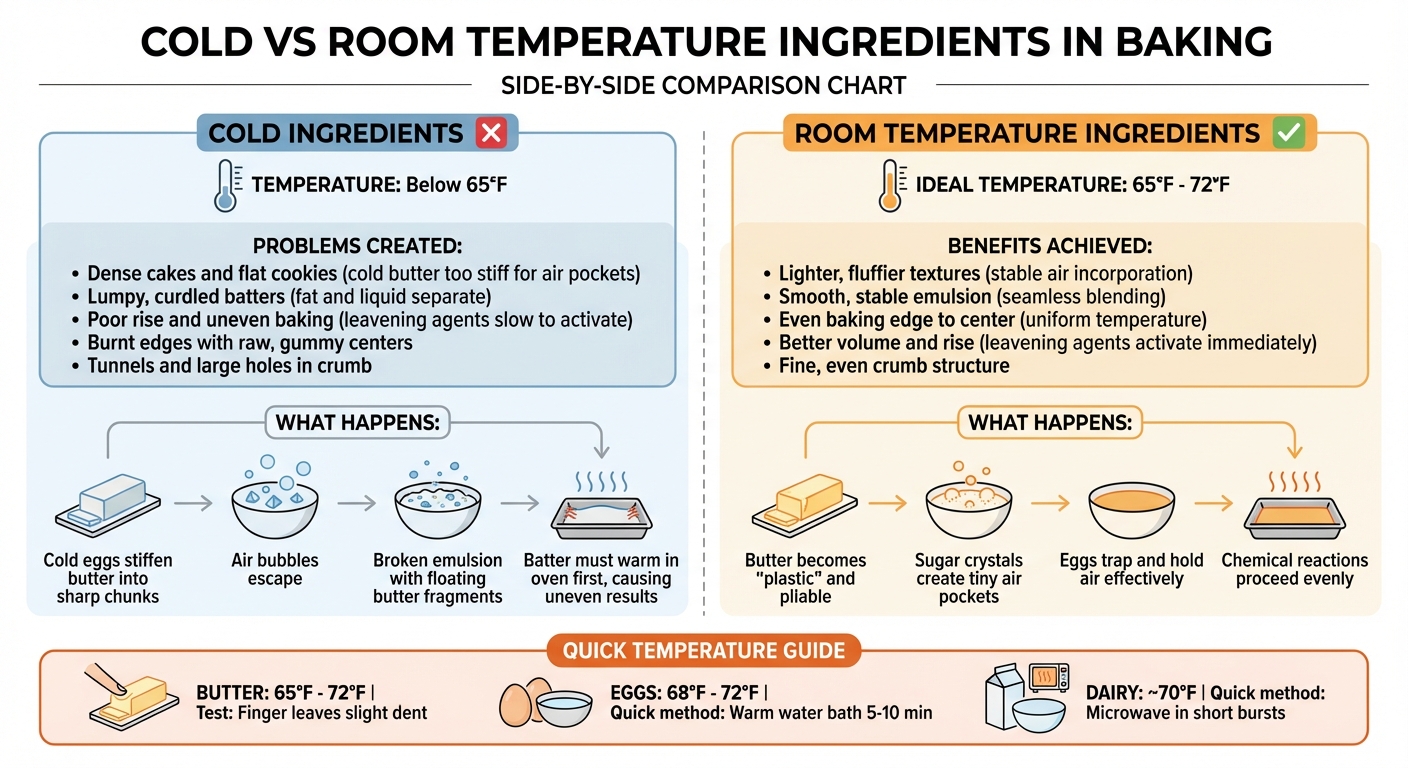
Cold vs Room Temperature Ingredients in Baking: Effects and Outcomes
INGREDIENT TEMPERATURE GUIDELINES FOR BAKING | room temperature ingredients vs cold ingredients
sbb-itb-663e316
The Problem: Using Cold Ingredients in Baking
Cold ingredients like butter and eggs can throw off the mixing process, leading to all kinds of baking issues. For example, cold butter doesn’t allow eggs to trap air properly, which can result in a batter that’s grainy and curdled. Let’s break down how cold ingredients can create specific problems in your baked goods.
Dense Cakes and Flat Cookies
Cold butter is too stiff for sugar to create those crucial tiny air pockets during the creaming process. When you add cold eggs to creamed butter, they form "small, sharp chunks" in the fat, which disrupt the air suspension. This causes the air bubbles to escape, leaving you with dense cakes or cookies that don’t spread as they should.
"The delicate butter-sugar-air combo you’ve just beaten together is damaged when the cold eggs stiffen the butter into small sharp chunks. This hardened butter rips apart the suspension – and all of a sudden, those air bubbles are gone." – PJ Hamel, Author and Baker
Lumpy Batters and Uneven Textures
Cold ingredients also make it hard to achieve a proper emulsion. Instead of blending smoothly, the fat and liquid separate, leaving you with a broken batter full of floating butter fragments. This curdled mixture can lead to cakes with tunnels and large holes instead of a fine, even crumb. To fix the lumps, bakers may overmix, which only develops too much gluten, resulting in a tough final product.
Poor Rise and Uneven Baking
Cold batters don’t rise well because leavening agents take longer to activate when the mixture starts off cold. This delay forces the oven to first warm the batter, which can lead to cakes with domed tops or uneven results – think burnt edges with a raw, gummy center.
"Curdled cake batters tend to rise poorly, so the finished cake will be rather dense. Cold, curdled batters tend to dome rather than bake up flat – and they’re often riddled with tunnels and holes." – Stella Parks, Author of BraveTart
Why Room Temperature Ingredients Work Better
Room temperature ingredients are a game changer in baking. They create stable mixtures, trap air effectively, and kickstart vital chemical reactions, all of which lead to better texture and flavor in your baked goods.
Creating a Stable Emulsion
Butter is a natural emulsion made up of about 80% fat and 20% water and milk solids. When butter is at room temperature (around 65°F to 70°F), it becomes "plastic", meaning it’s soft and pliable enough to stretch and blend without breaking. This state is crucial for forming a smooth, stable emulsion when combined with eggs and other liquids.
"Butter is an emulsion of about 80% fat and 20% water and milk solids… As an emulsion, butter is very sensitive to changes in composition and temperature."
- Charlotte Rutledge, Recipe Developer and Test Kitchen Manager
If you add cold eggs to softened butter, the sudden temperature drop can cause the fat in the butter to re-solidify, leading to clumps and a broken emulsion. Keeping all your ingredients at room temperature ensures they blend seamlessly, preventing clumping and allowing the mixture to retain air effectively.
This stable foundation is key to achieving the perfect batter consistency.
Incorporating Air for Lighter Textures
Once the emulsion is stable, room temperature ingredients help trap air during the creaming process, which is essential for adding volume and creating a lighter texture. When softened butter is creamed with sugar, the sugar crystals carve tiny air pockets into the butter. This process works best when the butter is at its ideal temperature – between 65°F and 67°F, according to America’s Test Kitchen.
"When you beat room-temperature butter with sugar… the sugar is able to perforate the butter and create tiny pockets of air. You’ll simultaneously get an even texture and more volume."
- Shauna Sever, Author
Eggs at room temperature also play a role. They trap and hold air more effectively, which is especially important when whipping egg whites. Room temperature egg whites whip into a glossier, taller foam that holds its structure better. These air pockets expand in the oven, giving your baked goods the lift they need for that light, fluffy texture.
Enabling Chemical Reactions
Room temperature ingredients don’t just improve texture – they also speed up the chemical reactions necessary for even baking. When ingredients are at the same temperature, they activate leavening agents like baking soda and baking powder right away, ensuring the batter rises evenly.
"Room temperature ingredients… will form an emulsion when we beat or whip them. As they form the emulsion, air is trapped which expands during baking resulting in a perfect fluffy cake."
- Lou Carruthers, Recipe Developer
Cold ingredients, on the other hand, can lead to uneven baking. Batters made with cold items often bake unevenly, with the edges cooking faster than the center, resulting in an undercooked or gummy middle. Room temperature ensures a uniform bake, from edge to center, every time.
Which Ingredients Need to Be at Room Temperature
When it comes to baking, knowing which ingredients need to be at room temperature can make all the difference. Butter, eggs, and dairy products are key players in most recipes, and their temperature directly impacts how well everything mixes and bakes.
Butter for Creaming
Butter should be between 65°F and 72°F to properly trap air during the creaming process. At this temperature, it becomes soft enough to work with but not so warm that it loses structure. When you cream butter with sugar, the sugar crystals create tiny air pockets in the butter, which help leavening agents do their job.
"In creaming the butter and sugar together, you are using the sugar to aerate the butter and fill it with bubbles that can capture the gasses released by your leavener."
- MaryJane Robbins, Employee-owner, King Arthur Baking
To check if your butter is ready, press your finger into it. It should leave a slight dent without feeling greasy or overly soft. If it’s too hard, it won’t cream properly, and if it’s too warm, it may turn oily – both of which can affect the texture of your baked goods.
Eggs for Whipping and Mixing
Room temperature eggs are essential for smooth mixing and achieving maximum volume. Cold eggs can cause creamed butter to seize up, leading to a curdled batter. Additionally, room temperature eggs whip up more easily, creating the volume needed for light and airy cakes or cookies.
"Eggs that are at room temperature are more easily and quickly dispersed and blended with the other ingredients to form a stable emulsion – you’ll recognize that ‘stable emulsion’ as a smooth, cohesive batter."
- Darcy Lenz, Food Writer and Recipe Developer, Allrecipes
If you forgot to take your eggs out ahead of time, don’t worry. Just place them in a bowl of warm water for 5–10 minutes to bring them up to temperature.
Dairy Products for Smooth Mixing
Dairy products like milk, cream, sour cream, yogurt, and cream cheese should also be at room temperature – around 70°F. Cold dairy can firm up butter and disrupt the emulsion, leading to lumps in your batter. For example, cold cream cheese can create stubborn lumps in cheesecakes or frostings.
To warm cream cheese quickly, cut it into small cubes and spread them out on a plate. They’ll soften in about 5–10 minutes. For liquid dairy, you can gently warm it in the microwave in short bursts, stirring in between, until it’s no longer cold to the touch.
When all your ingredients are close to the same temperature, they combine more easily, trapping air that expands in the oven. This results in a light, fluffy texture that makes your baked goods truly shine.
How to Bring Ingredients to Room Temperature Quickly
You don’t have to wait for hours to get your ingredients ready for baking. With a few clever tricks, you can have everything at the right temperature in just minutes, without affecting the quality of your baked goods.
Plan Ahead for Natural Warming
If you have some time to spare, set your ingredients out 30–60 minutes before you start baking. Butter typically softens in 60–120 minutes, while eggs warm up in about 30 minutes. This method is completely hands-off and ensures you won’t accidentally overheat or partially cook anything. While waiting, you can use the time to preheat your oven and measure your dry ingredients. But if you’re in a rush, the quick methods below will save the day.
Quick Methods for Eggs and Butter
For eggs, submerge them (still in their shells) in warm – not hot – water for 5–10 minutes. If an egg is cracked, place it in a stainless steel bowl set in warm water, stirring occasionally. This can bring the egg to about 70°F in just a minute or so.
For butter, cutting it into ½-inch cubes will help it soften in 15–30 minutes. Need it even faster? Try grating the butter – it’ll be ready almost instantly. Another option is to heat a glass bowl with hot water for 5 minutes, dry it off, and place it upside down over the butter. This method softens butter in about 5 minutes.
"Most people over-soften their butter. It should not be soft to the point where, if you touch it, it loses its shape. It should be firm and cold to the touch."
- Kim Anderson, Culinary Center Team Lead, Land O’Lakes
Using a Thermometer for Accuracy
For the most precise results, use a digital food thermometer to check the temperature of your ingredients. Butter should be between 65°F and 70°F, while eggs and other dairy should be around 68°F to 72°F. To measure eggs accurately, crack them into a bowl, whisk lightly, and then insert the thermometer. This prevents the common mistake of assuming ingredients are ready based on touch alone, as they might still be too cold inside.
The Results: Better Baking with Room Temperature Ingredients
Getting your ingredients to the right temperature can make a huge difference in the quality of your baked goods. Here’s how proper temperature control can elevate your baking:
Lighter Textures and Better Volume
Using room temperature ingredients can transform your baked goods, making them lighter and more airy. Why? Because softened butter, eggs, and milk create a stable emulsion that traps air pockets in the batter. As your cake bakes, these air pockets expand, giving it that fluffy lift. Softened butter also works with sugar crystals to form those air pockets, while room temperature eggs whip up more efficiently, helping create a moist, tender crumb.
Even Baking and Consistent Results
When all your ingredients are the same temperature, your batter mixes more evenly, which means it also bakes more evenly. This consistency ensures that leavening agents activate properly, avoiding issues like gummy centers, uneven doming, or tunnels in the crumb.
"When your ingredients are all the same temperature, they blend into a consistent batter. That means your cake bakes evenly from edge to center."
- Courtney Rich, Cake Specialist
Better Flavor and Appearance
Room temperature ingredients don’t just improve texture – they also enhance flavor and appearance. A batter made with properly tempered ingredients avoids the lumpy or curdled look of a broken mixture, giving you a smooth, professional finish. Butter softened to around 65°F to 67°F creates the ideal structure for both texture and appearance, ensuring your baked goods look as good as they taste.
The result? Baked goods that are lighter, bake evenly, and look picture-perfect every single time.
Conclusion
Baking success often hinges on one simple factor: temperature. Bringing butter, eggs, and dairy to about 65°F to 70°F before mixing can make all the difference. At this range, ingredients combine effortlessly, creating a stable emulsion that traps air. The result? Lighter textures, better volume, and consistently even bakes.
Room temperature ingredients don’t just blend more easily – they also ensure a smoother and more uniform bake. This balance of temperature is a small but essential detail that can elevate your baking.
"Think about your ingredients being at room temperature, the same as preheating your oven, and your bakes will have the best chance of being a perfect bake!"
- Lou Carruthers, Recipe Developer
To make this part of your routine, set out butter, eggs, and dairy 30 to 60 minutes before starting. If you’re pressed for time, there are quick fixes: place eggs in a bowl of warm water or cut butter into small cubes to speed up softening. These simple adjustments can have a big impact on your final results.
The reward? Cakes that rise beautifully, cookies with perfect structure, and batters that mix smoothly. Your baked goods won’t just taste better – they’ll have that tender, melt-in-your-mouth texture that sets them apart.
FAQs
What counts as “room temperature” for baking ingredients?
When a recipe calls for ingredients at "room temperature", it generally means around 68°F. At this temperature, butter is soft enough to bend without breaking, and eggs lose their chill, feeling slightly warm to the touch. This helps ingredients combine more smoothly, resulting in better texture and consistency in your baked goods.
Can I still bake if my butter or eggs are cold?
Yes, you can bake using cold butter or eggs, but using ingredients at room temperature typically gives better results. Why? Room temperature ingredients mix more smoothly, create better aeration, and emulsify properly. This leads to a smoother batter, improved texture, and a better rise in your baked goods. For the best outcome, let your butter and eggs sit out and warm up before you begin.
Which recipes don’t need room-temperature ingredients?
Recipes that skip room-temperature ingredients often feature items that benefit from being cold. For example, flaky pastries like croissants or puff pastry depend on cold butter to achieve their signature texture. Some quick breads and muffins might also bypass the need for softened ingredients, but this typically depends on the recipe. Always double-check the instructions to ensure you’re using ingredients at the right temperature for the best results.