
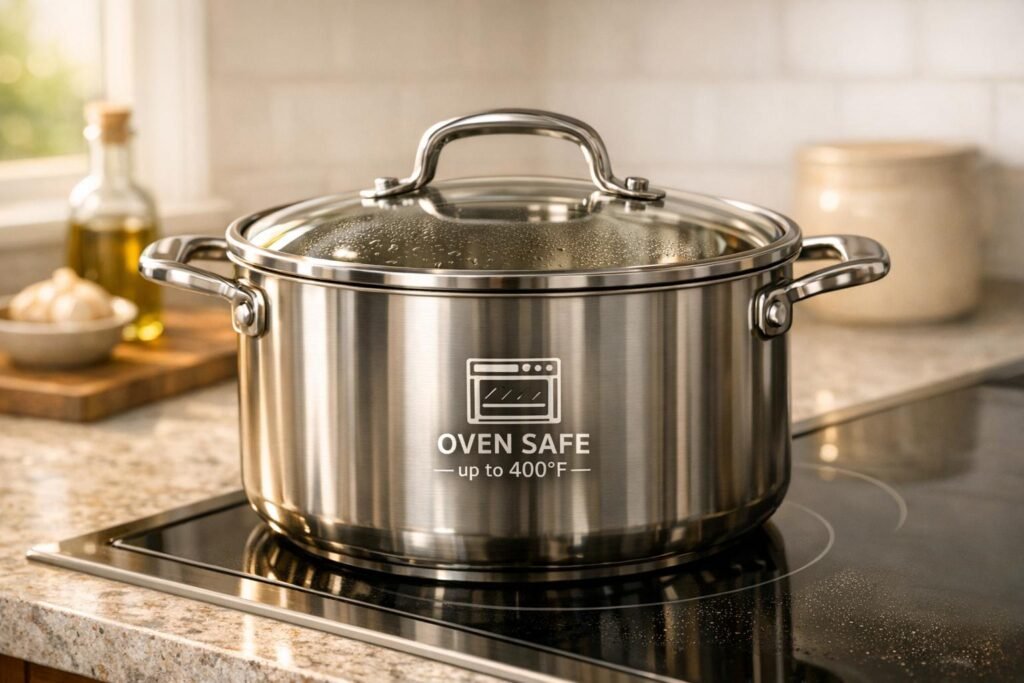
Not all cookware is oven-safe, and using the wrong type can lead to melting, warping, or even toxic fumes. Here’s how to determine if your cookware can handle oven use:
- Look for Oven-Safe Symbols: Check the bottom of the pan or handles for symbols like an oven icon, wavy lines, or text like "Oven Safe." These often include maximum temperature limits (e.g., "450°F").
- Inspect Materials:
- Safe Materials: Stainless steel, cast iron, carbon steel, and enameled cast iron typically handle high heat.
- Risky Materials: Nonstick coatings (limit ~400°F), plastic handles, and glass lids (limit ~350°F).
- Manufacturer Guidelines: If symbols are missing, consult the user manual or the brand’s website for heat limits.
- Test Unlabeled Cookware: Start with 200°F in the oven, then check for signs of damage like warping or odors.
Common Temperature Limits by Material:
- Cast Iron: Up to 900°F
- Stainless Steel: 500°F–800°F
- Nonstick Coating: 350°F–400°F
- Glass (e.g., Pyrex): ~450°F
Always verify the weakest component, such as handles or lids, as they set the overall limit. Avoid broiler use unless specified, as broilers exceed typical oven-safe temperatures. Testing cookware carefully can prevent damage and ensure safety.
How to Find and Read Oven-Safe Symbols
Where to Look for Oven-Safe Labels
Manufacturers typically mark oven-safe symbols and temperature limits on the underside of cookware. Look for symbols like a square with an oven or horizontal wavy lines. These markings are often etched, stamped, or printed.
For glass or ceramic bakeware, check areas like the handles or rim. Brands like Pyrex often include text such as "Oven Safe" or "Preheated Oven Only" in these spots. If you can’t find any markings, try checking the product’s packaging, user manual, or the manufacturer’s website using the model number.
Once you’ve located the symbols, it’s essential to understand what they mean, especially regarding heat limits.
What Common Oven-Safe Symbols Mean
Oven-safe symbols aren’t standardized, so they can vary across brands. Some of the most common include a drawing of an oven, a square with wavy lines, or straightforward text like "Oven Proof" or "Oven Safe". These symbols often include maximum temperature limits.
Pay attention to any temperature numbers near the symbol, such as "450°F" or "Safe up to 500°F." These indicate the maximum heat the cookware can withstand. Be careful not to confuse oven-safe icons with those for dishwasher or stovetop safety. Also, remember to check the lids and handles separately. Mary Rodgers, Director of Marketing Communications at Cuisinart, explains:
"All Cuisinart pans are oven-safe up to at least 350°F, but the stainless steel and hard-anodized aluminum collections are oven-safe up to 500°F."
However, their glass lids are only safe up to 350°F.
The table below highlights common brands, their symbols, typical temperature limits, and where to find the markings.
| Brand | Symbol Type | Typical Max Temperature | Where to Find It |
|---|---|---|---|
| T-fal | Wavy-line or temperature icon | 350°F–400°F | Bottom of the pan |
| Calphalon | "Oven Safe" etched text | 450°F–500°F | Bottom or handles |
| Lodge | Stamped "Oven Safe" text | 500°F+ | Bottom of cast iron |
| Pyrex | Etched text ("Oven Safe") | 425°F | Handles or rim |
| Le Creuset | Oven icon or stamped text | 500°F | Bottom of the piece |
| Cuisinart | "Oven Safe" text + symbols | 450°F–500°F | Bottom of the pan |
Checking Manufacturer Guidelines and Temperature Limits
Where to Find Manufacturer Instructions
If your cookware doesn’t have visible symbols indicating oven safety, the next step is to check the manufacturer’s documentation. Look at the original packaging or the user manual for details about oven-safe status and temperature limits.
If you don’t have the original paperwork, head to the manufacturer’s website. Use the specific product line name, like "Circulon Elementum", when searching. Brands often have different temperature limits across their product series, so being precise matters. On the official website, you’ll usually find product descriptions, care instructions, and technical specifications that outline safety ratings and handling tips for your cookware. Retailer websites are also helpful – many include oven-safe ratings and maximum heat thresholds in their product descriptions.
How to Read Maximum Temperature Ratings
Once you’ve gathered the manufacturer’s guidelines, it’s essential to understand how temperature ratings work. These ratings follow the "weakest link" principle, meaning your cookware’s maximum heat tolerance is determined by its most heat-sensitive part. For instance, a stainless steel pan might withstand up to 800°F, but if it has silicone handles rated for 400°F or a glass lid safe only to 350°F, those components set the actual limit.
Also, note the difference between "oven-safe" and "broiler-safe." These terms aren’t interchangeable. Broilers produce intense, direct heat that can exceed the limits of many oven-safe materials, including non-stick coatings and tempered glass. Circulon emphasizes this point:
"Cooking within your pan’s recommended temperature range is important for your health and safety, as repeatedly exposing a pan to too-high temperatures can cause elements to melt, or nonstick coatings to degrade."
The risks are real. For example, PTFE (Teflon) non-stick coatings can release toxic fumes if heated above 500°F (260°C). If your cookware’s lid can’t handle the temperature you need, a tight layer of aluminum foil can serve as a safe alternative.
Checking Handles, Lids, and Materials
Checking if Handles and Lids Are Oven-Safe
Once you’ve reviewed the symbols and guidelines, it’s time to examine the handles, lids, and materials to determine if your cookware can handle oven use. Handles and lids often make or break a pan’s oven compatibility. Handles made entirely of stainless steel, cast iron, aluminum, or copper are usually safe for high temperatures. Pay attention to how the handles are attached – metal rivets are a good sign, while plastic rivets are a clear indicator that the pan isn’t meant for the oven.
Steer clear of cookware with plastic or wooden handles. Plastic can melt, and wood is a fire hazard. If a handle feels like hard plastic or has a wood-like appearance, it’s best to avoid using it in the oven. Silicone-wrapped handles are a common feature in modern cookware and are designed to stay cool, but they generally have a heat limit of 350°F to 400°F.
When it comes to lids, tempered glass lids with steam vents are typically safe up to 350°F, while those without vents can often handle up to 500°F. For instance, the classic Le Creuset plastic knobs are only safe up to 375°F, even though the pot itself can withstand much higher temperatures. On the other hand, metal lids made from stainless steel or cast iron usually match the pan’s heat tolerance.
Common Oven-Safe Cookware Materials
The materials used in your cookware play a big role in determining its oven safety. Cast iron is one of the most durable options out there, capable of withstanding temperatures as high as 900°F. This applies to both bare and enameled cast iron, though enameled versions are generally capped at 500°F due to the coating. Stainless steel pans are incredibly versatile, with professional-grade options often tolerating 500°F to 800°F, depending on their quality.
Non-stick coatings, however, are a major limitation for oven use. PTFE (commonly known as Teflon) coatings can release harmful fumes if heated above 500°F. Hard-anodized aluminum pans are also restricted, typically rated for 400°F to 500°F due to their non-stick surfaces. Carbon steel pans, on the other hand, can handle up to 600°F, making them a great choice for high-heat cooking like roasting. As a general rule, most all-metal pans are safe for oven use up to at least 350°F.
How Do I Know If My Pan Is Oven-Safe? – LearnToDIY360.com
sbb-itb-663e316
Maximum Oven Temperatures by Cookware Material
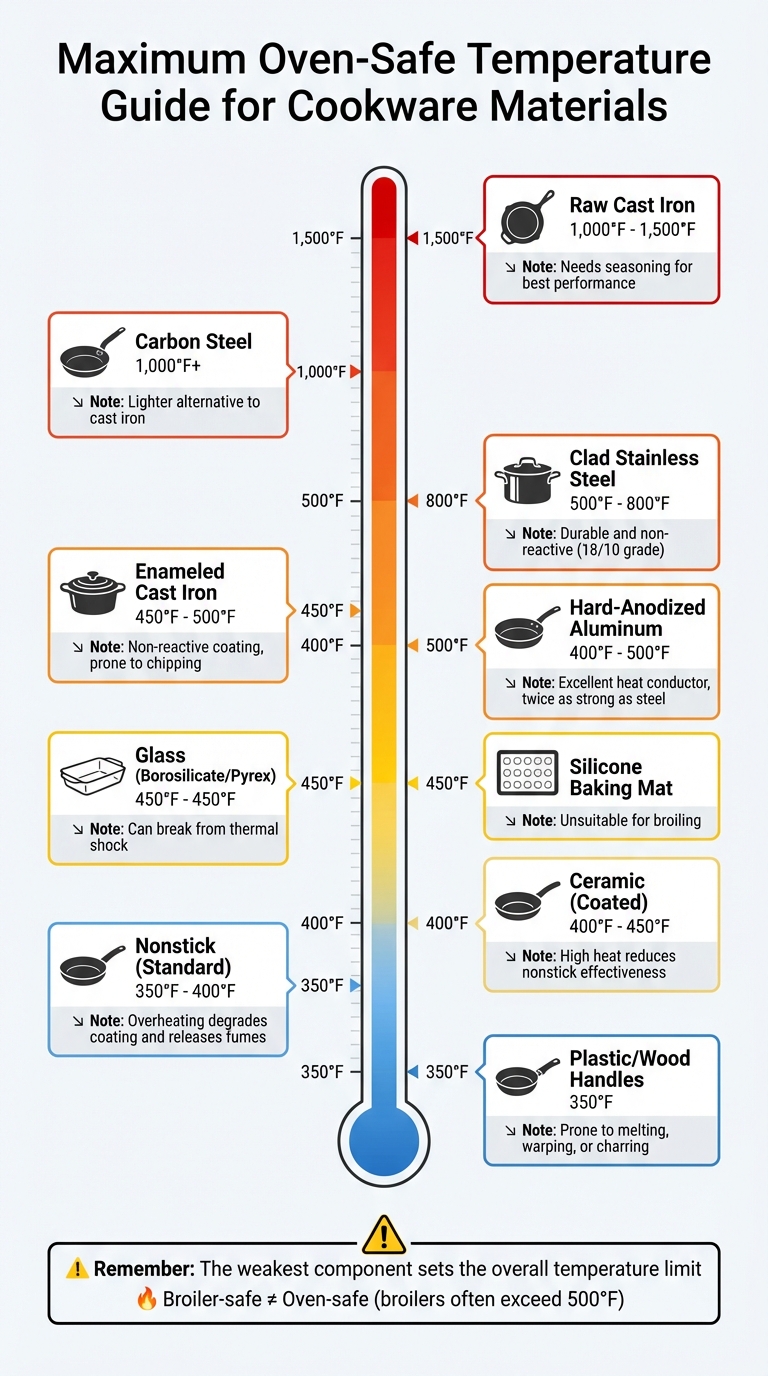
Oven-Safe Temperature Limits by Cookware Material
When it comes to cooking, the material of your cookware plays a big role in determining how much heat it can handle. Understanding these limits helps protect your pans from damage and ensures safe use in the oven.
Cookware Material Temperature Chart
The table below provides a handy guide to the maximum temperatures various cookware materials can withstand. Keep in mind that the weakest part of the cookware – like a plastic handle on a stainless steel pan – sets the overall temperature limit. Here’s what you need to know:
| Cookware Material | Typical Max Temperature | Notes |
|---|---|---|
| Raw Cast Iron | 1,500°F | Needs seasoning for best performance. |
| Carbon Steel | 1,000°F+ | Lighter alternative to cast iron. |
| Clad Stainless Steel | 500°F – 800°F | Durable and non-reactive, especially in 18/10 grade. |
| Enameled Cast Iron | 450°F – 500°F | Coating is non-reactive but prone to chipping over time. |
| Hard-Anodized Aluminum | 400°F – 500°F | Excellent heat conductor; twice as strong as steel. |
| Glass (Borosilicate/Pyrex) | 450°F | Can break from sudden temperature changes (thermal shock). |
| Silicone | 450°F | Flexible but unsuitable for broiling. |
| Nonstick (Standard) | 350°F – 400°F | Overheating can degrade the coating and release fumes. |
| Ceramic (Coated) | 400°F – 450°F | High heat may reduce nonstick effectiveness over time. |
| Plastic/Wood Handles | 350°F | Prone to melting, warping, or charring at higher temperatures. |
It’s also important to distinguish between oven-safe and broiler-safe cookware. Broilers often exceed 500°F, which can damage materials like nonstick coatings or glass. Always check the limits of each component before exposing your cookware to extreme heat.
How to Test Cookware Without Labels
When your cookware lacks labels or manufacturer guidelines, testing it is the safest way to determine if it can handle oven use. Start with low temperatures and proceed cautiously. Before testing, check for obvious signs of non-oven-safe materials, such as wood, plastic, or rubber components, which can’t withstand high heat.
How to Test at Low Temperature
Start by preheating your oven to 200°F. Place the empty cookware inside for 15 minutes, keeping an eye (and nose) out for smoke, chemical odors, or burning smells – these are clear signs of failure. After 15 minutes, use oven mitts to remove the cookware and inspect it for any damage, such as surface peeling, discoloration, or melting.
If the cookware passes this initial test, move on to a higher temperature test at 300°F. Place the empty cookware in the oven for 15 to 20 minutes at this temperature and check for warping or bending afterward. Maria J. Silva, Owner & Editor at OvenWave, explains:
"If the pan warps, bends, or makes a popping sound, it likely cannot withstand high oven temperatures".
Another option is the cold start method. Begin by placing the cookware in a cold oven, then set the temperature to 350°F. Observe the cookware as the oven heats up. If you notice popping sounds or warping, remove it immediately to prevent further damage.
Safety Tips for Testing Unlabeled Cookware
While testing, never place cookware in the oven during preheating. Brigitte Gemme, Founder and Food Educator at Vegan Family Kitchen, cautions:
"During the preheating phase, most ovens are sending blasts of heat at temperatures far higher than the target temperature… This can lead to breakage, even of high-quality oven resistant cookware like Pyrex".
Instead, wait until the oven has fully preheated before inserting the cookware. If your cookware includes a lid, test it separately following the same steps. Avoid using any items with plastic or other non-oven-safe materials. Once testing is complete, allow the cookware to cool completely on a heat-resistant surface before washing. Exposing hot cookware to sudden temperature changes can cause glass or ceramic to crack or shatter.
Finally, stay close to the kitchen during the entire process. Be prepared to turn off the oven immediately if you notice smoke, fumes, or any unusual odors. Safety should always come first.
Conclusion
Double-checking your cookware for oven safety is easier than you might think. Start by inspecting the bottom of your pans for an oven-safe symbol – usually a small oven icon with wavy lines or stamped temperature ratings . If you’re unsure, consult the manufacturer’s documentation to confirm the maximum heat limits for both the cookware and its components . For peace of mind, stick with all-metal options like cast iron or stainless steel, which can handle high temperatures (up to 900°F and 800°F, respectively). Avoid nonstick coatings when cooking above 400°F, as they can break down under extreme heat .
Maria J. Silva, Owner & Editor at OvenWave, highlights the risks of ignoring these guidelines:
"Using the wrong cookware can result in warping, melting, or even breaking".
For vintage or unlabeled cookware, a simple test at 200°F can help you catch potential issues before they become bigger problems .
FAQs
How can I check if my cookware’s handles and lids are safe for oven use?
To figure out if your cookware’s handles and lids are safe for oven use, start by checking the manufacturer’s label or instruction manual. Many will include specific temperature limits, like "oven-safe up to 350°F." If this information isn’t readily available, take a closer look at the materials. Metal handles, such as stainless steel or cast iron, can usually withstand heat up to 600°F. On the other hand, plastic or silicone handles generally have much lower heat limits, often around 350°F to 375°F. When it comes to lids, metal lids are typically safe for oven use, but glass or ceramic lids often have lower thresholds, usually around 400°F.
If you’re still uncertain, check for oven-safe symbols or temperature markings on the cookware itself. These are often located on the bottom or the original packaging. As a last resort, you can test the cookware by placing it in a preheated oven at 350°F for about 10 minutes to see if it holds up without damage. For the most accurate information, visiting the manufacturer’s website or contacting their customer service team is always a good idea. These steps can help you confidently and safely use your cookware in the oven.
What happens if I use cookware that isn’t oven-safe?
Using cookware that isn’t designed for oven use can cause a range of problems. For instance, materials like glass or ceramic might crack or even shatter when exposed to high heat. Thin metals or non-stick coatings can warp or melt, and handles made from plastic or other heat-sensitive materials may loosen or melt, increasing the chance of spills or burns. Even worse, non-stick coatings subjected to extreme heat can release toxic fumes, potentially harming your health and contaminating your food.
In some situations, cookware can break apart in the oven, leaving behind sharp fragments or debris that not only make cleanup hazardous but could also damage your oven. To steer clear of these issues, always check for an oven-safe symbol or verify the temperature limit on the manufacturer’s label or website. Make sure both the cookware and its handles are built to withstand the heat levels you plan to use.
How can I tell if my cookware is oven-safe if it’s not labeled?
To figure out if unlabeled cookware is safe for the oven, start by examining what it’s made of. Materials like cast iron, enameled cast iron, stainless steel, carbon steel, and certain aluminum alloys are generally safe for oven use. However, steer clear of cookware with plastic, wooden, or non-stick parts – these can melt, warp, or release harmful fumes when exposed to high heat.
If you’re not sure, try a quick test. Preheat your oven to 350°F, place the clean, empty cookware on the middle rack, and let it heat for 10–15 minutes. Using oven mitts, carefully remove it and inspect for any signs of damage, such as warping, cracking, discoloration, or odd smells. If the cookware looks and smells fine, it’s probably safe to use at standard baking temperatures.
Looking for more kitchen tips and tricks? Check out Comfy Kitchen for practical advice to make your cooking experience even better.