
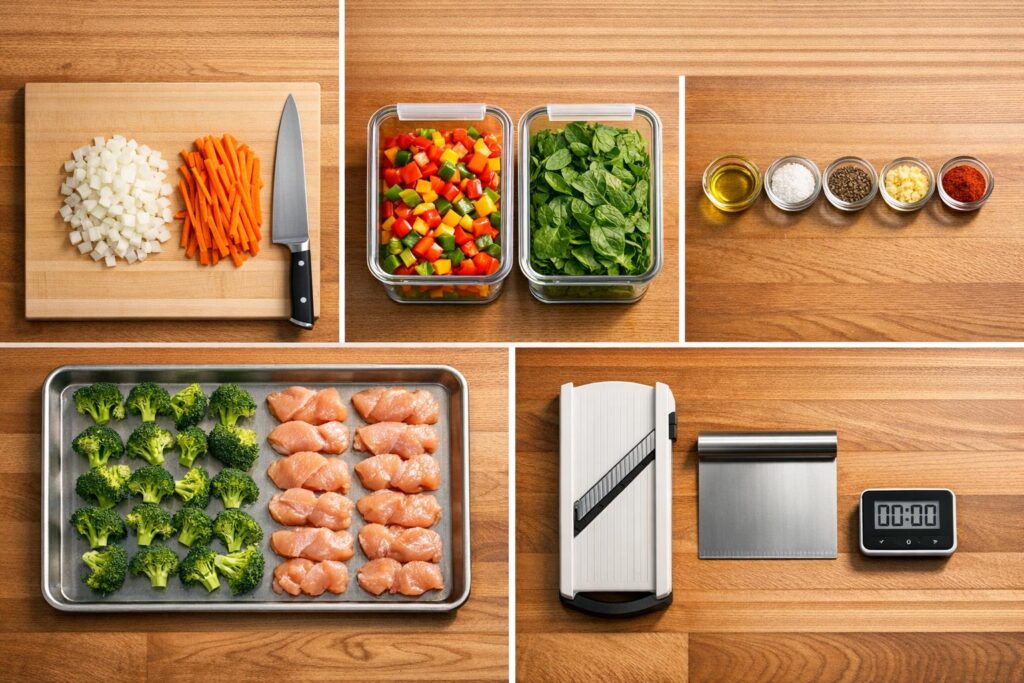
When you’re short on time, prepping ingredients in advance can make cooking simpler, safer, and more enjoyable. By organizing your workspace, mastering basic skills, and using the right tools, you can save time and reduce stress in the kitchen. Here’s a quick rundown of five ways to improve your prep game:
- Master Chopping Techniques: Use sharp knives, practice safe grips, and adopt efficient cutting motions like the rocking method. Stabilize your cutting board and ingredients for better results.
- Organize with Clear Containers: Store prepped ingredients in stackable, airtight containers to save space and keep food fresh. Label them for easy identification.
- Measure Before Cooking: Pre-measure ingredients using a digital scale or group them by cooking order to avoid interruptions and ensure consistent results.
- Batch Prep Common Ingredients: Chop vegetables, peel garlic, and cook grains or proteins in advance to save time during the week.
- Use Time-Saving Tools: Invest in gadgets like food processors, mandolines, and immersion blenders to speed up repetitive tasks.
These straightforward tips can help you cook more efficiently while keeping your kitchen organized. With a little planning, you’ll spend less time scrambling and more time enjoying your meals.
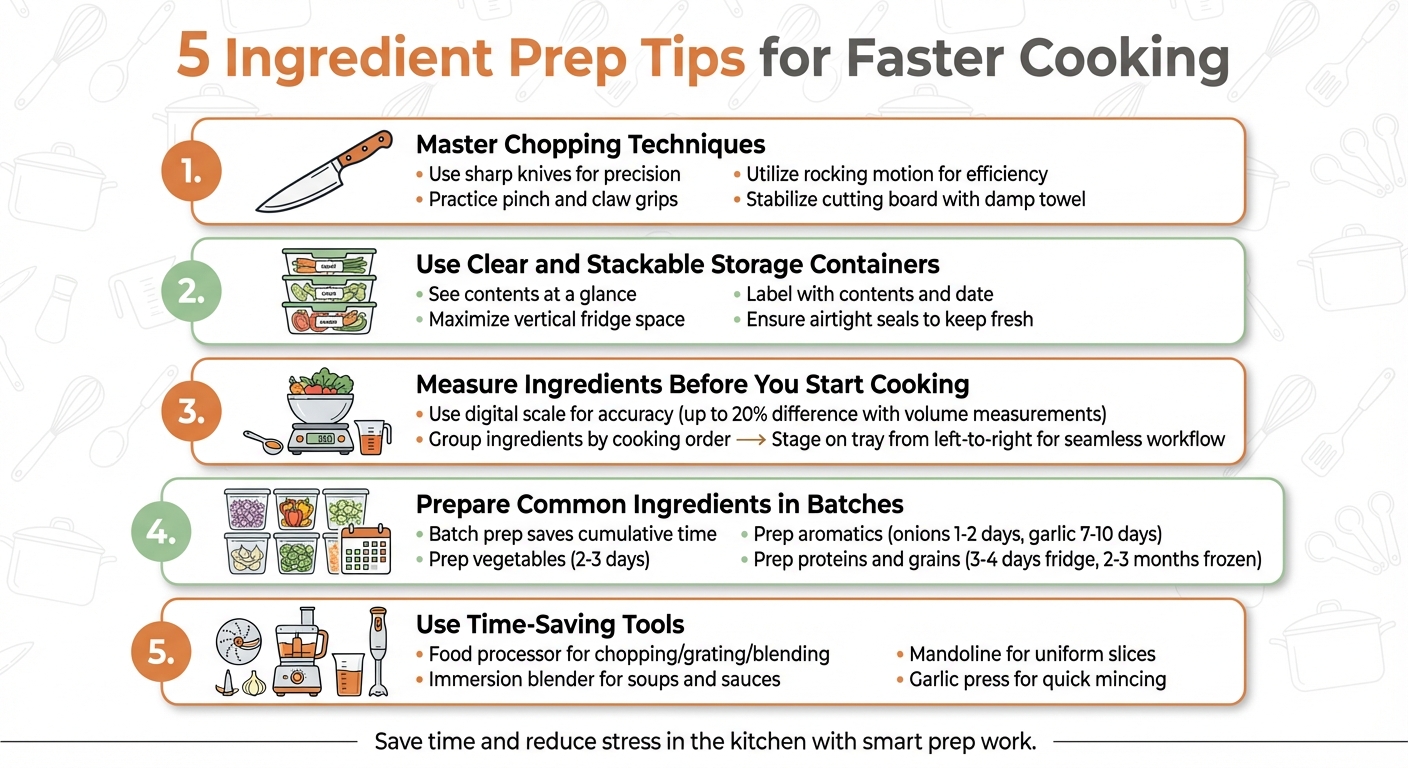
5 Ingredient Prep Tips for Faster Cooking Infographic
Meal prep ❌ vs. ingredient prep ✅
sbb-itb-663e316
1. Learn Better Chopping Techniques
Start with sharp knives – it’s non-negotiable. A dull knife not only slows you down but also increases the risk of injury. As food writer Miriam Nice explains:
"The biggest kitchen injuries often come from incorrect knife grips or dull blades."
A sharp blade also reduces onion-induced tears by slicing cleanly through the cells, causing less irritation. To keep your knives in top shape, sharpen them before use and schedule professional sharpening at least once a year.
Grasp the basics of two key grips: the pinch grip and the claw grip. The pinch grip gives you better control over the knife, while the claw grip protects your fingers from accidental nicks. Once you’ve got these grips down, focus on stabilizing your ingredients for safer and more uniform cuts.
Prevent rolling by slicing a flat edge on round vegetables. This simple adjustment makes chopping easier and steadier. When dicing onions, leave the root end intact – it holds the layers together, making the process safer and more efficient.
Adopt a rocking motion instead of chopping straight up and down. Keep the knife tip anchored to the cutting board while rocking the blade’s heel in a smooth curve. This technique is especially helpful for repetitive tasks like mincing garlic or dicing veggies and becomes second nature with practice.
To further streamline your prep, set up your workspace wisely. Place a damp paper towel under the cutting board to keep it from slipping, and use a bench scraper to transfer ingredients. This not only saves time but also spares your knife from unnecessary wear. These chopping techniques will make batch prepping quicker and your cooking process much smoother.
2. Use Clear and Stackable Storage Containers
Once you’ve got your chopping game on point, the next step is organizing your ingredients with clear, stackable containers. This simple shift can keep your kitchen running smoothly and efficiently.
Why clear containers? They take the guesswork out of meal prep. You can immediately see what’s inside and how much you have left – no more opening lids or rummaging through the fridge mid-recipe. Plus, in smaller kitchens, stackable containers help you maximize vertical space, making even the tiniest fridge or pantry feel more spacious.
Professional chefs swear by deli containers for a reason. Arnold Myint, chef at International Market 2.0, explains:
"Deli containers, masking tape, and markers are a must in order to stay organized. They are total space savers and great in the fridge, freezer, and dry pantry."
Stock up on 8-ounce, pint, and quart-sized deli containers. They’re affordable, stack neatly, and share interchangeable lids, making them a practical choice for every kitchen.
To stay organized, label the container itself (not the lid) with masking tape and a permanent marker. Include the contents and prep date to avoid mix-ups and reduce food waste.
For freshness, airtight containers are key. They lock in flavors, keep ingredients like prepped veggies crisp, and prevent odors – so those chopped onions won’t take over your fridge. For delicate items like leafy greens or herbs, add a damp paper towel on top before sealing to maintain the ideal moisture level.
Don’t stop at perishables. Transfer dry goods like flour, sugar, rice, pasta, and cereal into clear jars. Not only do they save space, but they also let you keep an eye on your inventory, making grocery shopping easier and more efficient.
3. Measure Ingredients Before You Start Cooking
Once you’ve organized your ingredients in clear, stackable containers, the next step is to measure them accurately before you start cooking. Pre-measuring not only keeps your workflow uninterrupted but also ensures consistent results every time.
A digital kitchen scale is a game-changer for accurate measurements. Unlike measuring cups or spoons, which can vary significantly – especially for powdered or granulated ingredients, where volume measurements can differ by up to 20% – a scale provides precision. Leslie Jeon from Food Blogger Pro highlights its efficiency:
"The beautiful part about using a digital scale to weigh your ingredients is that you can make use of the tare feature… it will save you time in the end."
Accurate measuring is especially useful for batch cooking, as it reduces errors and cleanup, keeping your kitchen running smoothly.
Another tip for staying organized is grouping ingredients by their cooking order. Patty Catalano, Food Editor at The Kitchn, offers this advice:
"Read through the text of the recipe before lifting your knife to identify ingredients that are added to the pan at the same time, then prep them and pile them in the same prep bowl."
This method not only streamlines your process but also minimizes the number of dishes you’ll need to wash later.
For added efficiency, use a tray or large plate as a staging area. Arrange ingredients left-to-right in the order they’ll be used. Peggy Aoki from Tasting Table suggests:
"Bring all of the items you need with you when you turn on the stove, then nothing will burn while you scramble to get the next ingredient."
If you want the best results, consider investing in a digital kitchen scale with a tare function. For example, the OXO Good Grips model (around $55) allows you to measure multiple ingredients in the same bowl by resetting the scale to zero between additions. This not only saves time but also cuts down on cleanup.
4. Prepare Common Ingredients in Batches
Taking the idea of pre-measured ingredients a step further, batch prepping can make your cooking process even smoother. Dedicate 30 minutes once or twice a week to prepare commonly used ingredients like onions and garlic in advance. As Perry’s Plate notes:
"Batch chopping vegetables is much more efficient than the cumulative time it takes to chop things before every meal."
Start with aromatics such as onions, garlic, and ginger. Chop onions and store them in an airtight container for 1–2 days – just make sure to double-bag them to keep odors contained. You can peel garlic cloves and store them for 7–10 days, or mince the garlic and freeze it in oil (using 1/2 teaspoon per clove) for up to 6 months.
For hearty vegetables, wash, chop, and store items like carrots, celery, and bell peppers for 2–3 days. Root vegetables, including beets and sweet potatoes, can last 7–10 days if stored properly. When it comes to herbs, freeze sturdy varieties like rosemary, thyme, and sage in ice cube trays with either water (for soups) or oil (for sautés). Andrea Rivera Wawrzyn, Associate Food Editor at The Kitchn, highlights the benefits:
"Doing this little bit of pre-prep work has the potential to improve almost anything that comes out of your kitchen – even if it’s just leftovers."
Batch prepping isn’t just for veggies and herbs – proteins and grains are excellent candidates too. Cook chicken, rice, quinoa, or beans in large quantities, then store them in the fridge for 3–4 days or freeze them for 2–3 months. Hard-boiled eggs can also be prepped and kept unpeeled for up to a week.
5. Use Kitchen Tools That Save Time
Once your ingredients are prepped, the right tools can make a world of difference in speeding up your kitchen tasks. The right gadgets can transform time-consuming chores into quick, effortless steps.
Take a food processor, for example. This multitasking powerhouse can chop, grate, and blend with just the push of a button. As America’s Test Kitchen explains:
"Your food processor can do the work of a whole set of knives, a meat grinder, a food mill, a box grater, a mandolin, a stand mixer, a blender – and do it all faster – with just the touch of a button."
Need to shred a pile of vegetables? The shredding disk handles it in seconds, saving you from sore arms. For precise, uniform slices, a mandoline is your go-to tool, perfect for making chips, salads, or gratins in no time.
Even smaller tools can pack serious efficiency. A garlic press quickly minces cloves while keeping your hands odor-free. An immersion blender purees soups or emulsifies sauces like hollandaise directly in the pot – no messy transfers needed. And a box grater turns hard vegetables into fine shreds in moments.
To maximize your food processor’s performance, try using the pulse function for better control over texture – this prevents over-processing ingredients into mush. Spraying the shredding disk and feed tube with a bit of vegetable oil can also help keep ingredients from sticking. When slicing, pack the feed tube tightly to ensure even cuts.
If you’re looking for recommendations, the Cuisinart 14-Cup Food Processor ($250–$320) is a top pick according to Food & Wine, thanks to its powerful motor and simple two-button operation. For smaller tasks or tighter budgets, the Fullstar Vegetable Chopper ($30) or OXO Good Grips Compact Chopper ($25) are excellent alternatives. Whether you’re dicing onions, shredding cheese, or slicing veggies, there’s a tool to make the job faster and easier.
Conclusion
Streamlining your prep work can completely change how you approach cooking. By honing your chopping skills, organizing your storage, prepping ingredients in advance, and using the right tools, you can turn weeknight cooking into a smoother, more enjoyable experience. As Jess Eng from Serious Eats points out:
"Learning how to prep smarter can help streamline cooking and cleaning up, and, most importantly, make cooking a more enjoyable experience."
These tips are adaptable, letting you focus on what matters most for your kitchen. Maybe that means investing in clear, stackable containers or simply keeping a "garbage bowl" nearby while you cook. Each small step builds on the last, helping you create a workflow that feels natural and efficient. Over time, cooking can shift from being a chaotic scramble to a calm, almost meditative process.
The advantages go far beyond saving time. Proper prep improves safety, ensures even cooking, keeps your workspace tidy, and helps you reduce waste. With less stress and more enjoyment, you might even start looking forward to cooking.
Efficiency doesn’t mean rushing – it’s about making the best use of your time. As The Kitchn Editors explain:
"Efficiency is often less about speed, and more about eliminating down time – making sure you’re using the time wisely."
For more practical advice on kitchen prep and recipes that are easy to follow, check out Comfy Kitchen. You’ll find everything from knife skills to tool recommendations, all designed to help you enjoy cooking more and stress less.
FAQs
What should I prep first to save the most time?
To save time in the kitchen, make sure to prep all your ingredients before you start cooking. This includes tasks like chopping vegetables, measuring spices, and organizing everything you’ll need. Having everything ready to go ensures a smoother, faster cooking process – no scrambling mid-recipe!
How long do prepped ingredients stay fresh in the fridge?
Prepped ingredients generally remain fresh in the fridge for 3 to 5 days. However, the exact timeframe can vary based on the type of food and storage method. To keep them at their best, use airtight containers and ensure your fridge maintains the right temperature to preserve both freshness and safety.
Which kitchen tool saves the most prep time?
A vegetable chopper is a game-changer when it comes to cutting down prep time in the kitchen. Whether you go for a manual or electric version, these tools can make quick work of chopping ingredients for your favorite recipes – think soups, salads, or salsas. While a dependable kitchen knife is a must-have, a vegetable chopper steps in to save the day when you’re handling large amounts of veggies, making the process faster and far less tedious.