

Handling raw meat safely is critical to avoid foodborne illnesses caused by bacteria like Salmonella and E. coli. These bacteria can spread through improper handling, leading to serious health risks. But the good news? Following a few straightforward steps can keep your kitchen safe.
Here’s a quick summary of the 10 tips to minimize contamination risks:
- Wash your hands: Clean with soap and warm water for at least 20 seconds before and after touching raw meat.
- Pick fresh meat: Check color, texture, and packaging at the store.
- Store meat properly: Keep it on the bottom shelf in sealed containers.
- Use separate cutting boards: Dedicate one for raw meat and another for ready-to-eat foods.
- Separate utensils and plates: Avoid reusing anything that touched raw meat for cooked food.
- Thaw in the fridge: Never thaw meat on the counter to keep it out of the "Danger Zone."
- Clean surfaces immediately: Use hot, soapy water to wash tools and counters after handling raw meat.
- Keep raw meat away from produce: Bag and store separately to prevent cross-contamination.
- Cook to safe temperatures: Use a food thermometer to ensure meat reaches the correct internal temperature.
- Boil marinades before reusing: If marinade touched raw meat, boil it to kill bacteria.
Food safety starts with simple habits like handwashing, proper storage, and cooking meat thoroughly. These steps help protect you and your family from harmful bacteria.
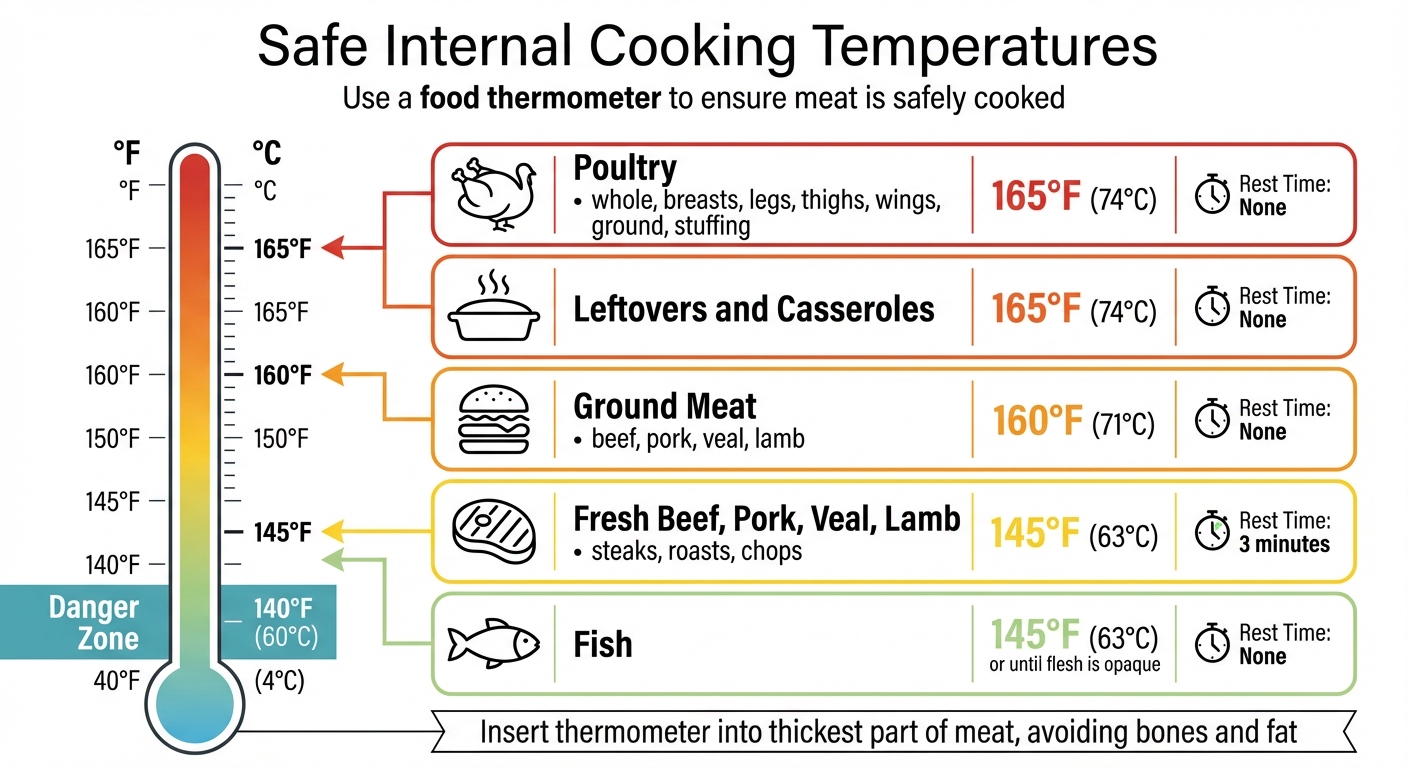
Safe Internal Cooking Temperatures for Meat and Poultry
Handling Raw Meat – Dietitian Dish
1. Wash Your Hands Thoroughly
Your hands are one of the main ways bacteria from raw meat can spread around your kitchen. When handling raw chicken, beef, pork, or seafood, harmful bacteria like Salmonella and E. coli can stick to your skin. If you don’t wash your hands properly, these germs can end up on spice jars, refrigerator handles, your phone, and even make their way into your body through your eyes, nose, or mouth.
To prevent this, wash your hands with soap and warm water for at least 20 seconds both before and after handling raw meat . Wet your hands, apply soap, and lather well – don’t forget the backs of your hands, between your fingers, and under your nails. Rinse thoroughly. A simple way to time this is by singing "Happy Birthday" twice. Washing beforehand helps keep germs already on your hands from contaminating the food, while washing afterward removes any bacteria picked up from raw meat juices.
The CDC has stressed the importance of handwashing, stating that "Handwashing with soap is one of the best ways to stay healthy". Proper handwashing can prevent about 1 in 3 cases of diarrheal illnesses and 1 in 5 respiratory infections.
If you have cuts or scrapes on your hands, use clean disposable gloves, but still make sure to wash your hands before and after handling raw meat. And remember – never wash raw meat itself. Splashing water can spread bacteria to nearby surfaces, increasing the risk of contamination.
The USDA reminds us that "cleanliness is a major factor in preventing foodborne illness". Washing your hands is the first step in keeping your kitchen safe and your family healthy. Once your hands are clean, you’re ready to safely handle and prepare fresh meat.
2. Choose Fresh Meat at the Store
When you’re at the store, inspecting meat for freshness is key. Start with the color – fresh beef should be bright red on the outside, while pork and poultry should have a healthy pink hue. Avoid any meat with grey, brown, or greenish tones. As Healthline explains, "Fresh, raw ground beef should be red due to its levels of oxymyoglobin – a pigment formed when a protein called myoglobin reacts with oxygen". It’s normal for the inside of ground beef to appear greyish-brown since it doesn’t get much oxygen, but the exterior should remain red. Paying attention to these color signs helps you pick meat at its freshest.
Texture is another indicator of freshness. Fresh meat should feel firm, slightly moist, and never sticky or slimy. A slimy or tacky texture is a red flag for spoilage. Healthline notes, "A sticky or slimy texture – either when cooked or raw – may indicate the presence of spoilage bacteria. You should toss it immediately". When you press the packaging, it should feel cold and firm, not mushy or slippery.
Inspect the packaging carefully. Only buy meat that’s cold to the touch and sealed properly without any holes, tears, or leaks. The USDA advises, "Never choose meat or poultry in packaging that is torn or leaking". Damaged packaging can let bacteria-laden juices contaminate other items in your cart. For added protection, grab one of those plastic bags in the meat section and wrap your package before placing it in your cart. This simple step prevents cross-contamination if any juices do leak. Keep in mind that vacuum-sealed meat can stay fresh for up to 7 days from purchase, while meat in standard overwrap packaging is safe for about 3 days.
Pay attention to dates on the label. The "sell-by" date is for store use, indicating when the product should be removed from shelves. Typically, you have 1 to 3 days after this date to safely use the meat. The "use-by" or "freeze-by" date is more important for you – make sure to cook or freeze the meat by this date to maintain quality and safety. Michigan State University Extension offers a simple rule of thumb: "When in doubt, throw it out".
Timing matters, too. Pick up meat as the last stop during your grocery trip to keep it cold as long as possible. If the temperature outside is above 90°F, make sure to refrigerate your meat within 1 hour of purchase; otherwise, you have up to 2 hours. Ground beef, which makes up about 62% of all beef sold in the U.S., is a staple for most home cooks, so knowing how to select it safely is especially important. With around 48 million cases of foodborne illness reported annually in the U.S. – affecting 1 in 6 Americans – spending a few extra moments to carefully choose your meat is a small effort that pays off big.
3. Store Raw Meat on the Bottom Shelf
The bottom shelf of your fridge is the safest place for raw meat, poultry, and seafood. Why? Keeping these items low prevents their juices from dripping onto ready-to-eat foods like salads or leftovers, which helps lower the risk of cross-contamination.
The CDC puts it plainly: "Raw meat, chicken and other poultry, seafood, and eggs can spread germs to ready-to-eat food unless you keep them separate". This isn’t just about keeping things tidy – it’s about protecting your family’s health. Proper storage plays a key role in maintaining a safe kitchen environment.
Always wrap raw meat securely and use a sealed container. The USDA advises, "Perishable food such as meat and poultry should be wrapped securely to maintain quality and to prevent meat juices from getting onto other food". To be extra cautious, place the wrapped meat on a plate or in a container to catch any leaks. This double-layer protection is especially important when thawing meat in the fridge. As the USDA points out, "Make sure thawing meat and poultry juices do not drip onto other food".
Keep your refrigerator at 40°F or lower, and use an appliance thermometer to check. The FDA also recommends separating raw meat, poultry, seafood, and eggs from other foods – starting at the grocery store and continuing all the way to proper storage at home. These small steps can make a big difference in food safety.
4. Use Separate Cutting Boards
After mastering proper food storage, it’s time to focus on using tools correctly. Cutting boards, in particular, can be a major source of cross-contamination in home kitchens. The USDA’s Food Safety and Inspection Service puts it plainly:
"Cross-contamination is the transfer of harmful bacteria to food from other foods, cutting boards, and utensils and it happens when they are not handled properly".
To cut down on this risk, keep things simple: dedicate one cutting board for raw meat, poultry, and seafood, and another for fresh produce, bread, and other ready-to-eat foods. Shockingly, only 32% of people clean and sanitize their surfaces properly after handling raw meat. That’s a habit worth changing.
If you’re working with just one cutting board, start by prepping fruits and vegetables first. Set them aside, then thoroughly wash the board with hot, soapy water before moving on to raw meat. This small step can make a big difference.
For raw meat, opt for cutting boards made from non-porous plastic or wood-fiber composite. These materials are usually dishwasher safe, which means you can sanitize them with high heat – much more effective than hand washing. If you’re cleaning by hand, scrub the board with hot, soapy water and sanitize it using a mixture of one tablespoon of unscented liquid chlorine bleach per gallon of water.
Lastly, don’t overlook wear and tear. Once a cutting board develops deep grooves or cracks, it’s time to replace it. These imperfections can trap bacteria, making proper cleaning nearly impossible and putting your family’s health at risk.
5. Keep Utensils and Plates Separate
Just like cutting boards, utensils and plates need their own separation rules in the kitchen. This simple step can stop bacteria from raw meat from making their way to your cooked meals. The FDA explains it best:
"If cooked food is placed on an unwashed plate that previously held raw meat, poultry, or seafood, bacteria from the raw food could contaminate the cooked food".
This advice is especially important when grilling outdoors. Using the same platter for raw and cooked meat is a quick way to transfer raw juices onto your finished dish. To avoid this, always use separate plates and utensils for raw and cooked items. If you need to reuse utensils, make sure to wash them thoroughly with hot, soapy water. Don’t forget to clean food thermometers between uses, too.
The USDA echoes this caution with a clear message:
"Any bacteria present in the raw meat or juices can contaminate the safely cooked product. Serve cooked products on clean plates, using clean utensils and clean hands".
With foodborne illnesses affecting 1 in 6 Americans annually – roughly 48 million cases in total – these small, mindful steps can make a huge impact. Just like separate cutting boards, designated plates and utensils are essential for keeping your food safe and your meals enjoyable.
sbb-itb-663e316
6. Thaw Meat in the Refrigerator
Always thaw meat in the refrigerator, not on the counter, to ensure it stays at a safe temperature of 40°F or below throughout the process.
When meat is left to thaw on the counter, the outer layer warms up quickly and enters the "Danger Zone" (40°F–140°F), where bacteria can multiply at an alarming rate. According to the USDA:
"Even though the center of the package may still be frozen as it thaws on the counter, the outer layer of the food could be in the ‘Danger Zone,’ between 40 and 140 °F – temperatures where bacteria multiply rapidly."
Planning ahead by using the refrigerator keeps your food safe and avoids cross-contamination risks. For smaller items like a pound of ground meat or boneless chicken breasts, you’ll need about 24 hours to thaw them in the fridge. Larger cuts, such as roasts, require more time – roughly 24 hours for every 5 pounds of meat. To prevent any mess or contamination, place the thawing meat on a plate or a rimmed pan to catch any drips.
Refrigerator thawing also gives you some flexibility. Once thawed, ground meat, poultry, and seafood can remain safe in the fridge for 1 to 2 days before cooking. Red meat cuts, like steaks and roasts, can be stored for 3 to 5 days. Plus, meat thawed this way can be refrozen without cooking it first, which can be helpful if plans change. If you’re in a pinch, you can cook meat directly from frozen – just be sure to increase the cooking time by about 50%.
Once you’ve thawed the meat safely, don’t forget to clean all surfaces and tools immediately after handling raw meat to maintain food safety.
7. Clean Surfaces and Tools Right Away
Once you’ve safely thawed raw meat, it’s crucial to clean all surfaces and tools immediately. This step is key to removing any bacteria that might linger on cutting boards, knives, or countertops. Using hot, soapy water is one of the most effective ways to tackle harmful pathogens like Campylobacter, Salmonella, and Yersinia. By cleaning right away, you help prevent these bacteria from spreading to other foods or areas in your kitchen.
The USDA emphasizes this point clearly:
"Cleanliness is a major factor in preventing foodborne illness."
Just as storing and separating raw meat properly helps avoid cross-contamination, cleaning tools and surfaces promptly minimizes the risk of bacterial transfer. Wash cutting boards, dishes, utensils, and countertops thoroughly with hot, soapy water after they’ve come into contact with raw meat. Don’t forget to clean items like thermometers between uses to ensure they’re safe for the next step of your meal prep.
When dealing with raw meat juices, use paper towels for easy disposal, or wash cloth towels frequently on a hot cycle to kill any lingering germs. For an added layer of safety, sanitize cutting boards with a solution made from 1 tablespoon of unscented liquid chlorine bleach mixed with 1 gallon of water. Let the solution sit on the surface for a few minutes before rinsing. Also, keep an eye on your cutting boards – replace any that develop deep grooves where bacteria can hide. Non-porous boards made from acrylic, plastic, or glass are a smart choice, as they can be safely cleaned in a dishwasher for a more thorough wash.
8. Keep Raw Meat Away from Produce
After properly storing and cleaning your food, it’s critical to keep raw meat completely separate from produce to minimize the risk of cross-contamination.
Raw meat and produce are two of the biggest culprits when it comes to bacterial cross-contamination in the kitchen. Keeping them apart is not just a suggestion – it’s a must for ensuring your family’s safety.
When shopping, bag raw meat separately to stop juices from leaking onto produce in your cart. Once home, store raw meat in leak-proof containers on the bottom shelf of your fridge. This way, if the packaging happens to leak, any juices stay contained and don’t drip onto other foods.
Your refrigerator’s crisper drawers are specifically designed for fruits and vegetables – stick to using them exclusively for produce. To further protect your food, keep your fridge at or below 40°F (use an appliance thermometer to double-check). If space is tight, prioritize vertical organization: store raw meat on the lowest shelf and produce higher up. This setup helps reinforce safe storage habits.
Make sure to refrigerate raw meat within 2 hours of buying it – or within 1 hour if it’s hotter than 90°F outside. If you’re marinating meat, always do so in a sealed bag or covered dish in the fridge to avoid any accidental splashes. As Simone Sonnier from UT Physicians puts it:
"Containment is key to preventing cross contamination."
9. Cook to the Right Internal Temperature
Looks can be deceiving when it comes to cooking meat – just because it appears done doesn’t mean it’s safe to eat. Harmful bacteria can still linger, and the only reliable way to ensure your food is safe is by using a food thermometer.
To get an accurate reading, insert the thermometer into the thickest part of the meat, avoiding any bones or fat. For thinner items like burgers or fish fillets, slide the thermometer in from the side to reach the center. When cooking whole poultry, check the temperature in the innermost part of the thigh to ensure it’s fully cooked.
Here’s a breakdown of the minimum internal temperatures you should aim for:
- Poultry: Cook to 165°F throughout.
- Ground meats (like beef, pork, or lamb): Heat to 160°F, as grinding can spread bacteria throughout the meat.
- Steaks, roasts, and chops (beef, pork, veal, or lamb): Cook to 145°F, then let the meat rest for 3 minutes. This resting period allows the temperature to stabilize or rise slightly, helping to eliminate any remaining pathogens.
- Fish: Safe at 145°F or when the flesh turns opaque and flakes easily with a fork.
For quick reference, here’s a handy table of safe cooking temperatures:
| Food Type | Minimum Internal Temperature | Rest Time |
|---|---|---|
| Poultry (Whole, breasts, legs, thighs, wings, ground, and stuffing) | 165°F (74°C) | None |
| Ground Meat (Beef, pork, veal, lamb) | 160°F (71°C) | None |
| Fresh Beef, Pork, Veal, Lamb (Steaks, roasts, chops) | 145°F (63°C) | 3 minutes |
| Fish | 145°F (63°C) or until flesh is opaque | None |
| Leftovers and Casseroles | 165°F (74°C) | None |
Using a food thermometer is one of the simplest ways to significantly lower the risk of foodborne illnesses. Don’t skip this step – it’s worth the extra effort for peace of mind and a safe meal!
10. Boil Marinades Before Reusing
Reusing marinade that has come into contact with raw meat is a big no-no when it comes to food safety. Once a marinade has touched raw meat, poultry, or seafood, it can carry harmful bacteria. If you brush that marinade onto cooked food without taking precautions, you’re essentially inviting those germs back to the table.
The FDA makes it clear:
"Don’t reuse marinades used on raw foods unless you bring them to a boil first."
Boiling is the only surefire way to kill any bacteria lingering in a used marinade. For it to be effective, you need to bring the marinade to a full, rolling boil. This ensures it reaches a temperature well above the danger zone (40°F to 140°F), where bacteria thrive. If you’d rather skip boiling altogether, the best option is to set aside a clean portion of the marinade before it ever touches raw meat.
Here’s a safe method: pour out what you’ll need for later use into a separate container before adding the raw meat to the rest. This way, you don’t have to worry about boiling or contamination at all.
If you do decide to boil a used marinade, make sure to use clean utensils when applying it to your cooked food. And remember, always marinate meat in the refrigerator, using a sealed, leakproof container or plastic bag. Leaving it out at room temperature is a recipe for bacteria growth – and a potential health hazard.
Conclusion
Handling raw meat doesn’t have to be complicated – as long as you stick to the basics. The 10 tips in this guide focus on the four cornerstones of food safety: Clean, Separate, Cook, and Chill. Together, these steps are your best defense against foodborne illness. As the USDA emphasizes:
"Safe steps in food handling, cooking, and storage are essential in preventing foodborne illness".
Every action you take in the kitchen – from scrubbing your hands for at least 20 seconds to using a food thermometer – plays a part in creating a safer cooking environment. Harmful bacteria are invisible, so building good habits is the only way to keep them in check.
Once you bring meat home, the responsibility for its safety is in your hands. While government agencies regulate food safety at the processing level, your kitchen practices are what ultimately protect your family. Use the storage and separation techniques outlined earlier to avoid cross-contamination, a leading cause of foodborne illnesses.
Temperature control is another critical piece of the puzzle. Bacteria thrive in the "Danger Zone" between 40°F and 140°F. Keeping meat properly refrigerated, thawing it safely, and cooking it to the recommended internal temperatures neutralizes these risks.
For more tips and practical advice, check out Comfy Kitchen. It’s a great resource for easy-to-follow guides and answers to common kitchen questions, all aimed at making your cooking experience safer and stress-free.
FAQs
Why should you use separate cutting boards for raw meat and other foods?
Using different cutting boards for raw meat and other foods is a key step in avoiding cross-contamination. Raw meat often contains bacteria such as Salmonella or E. coli, which can easily spread to fruits, vegetables, or other ready-to-eat ingredients if they’re prepared on the same surface.
By dedicating separate cutting boards for raw meat and other foods, you minimize the chance of bacteria transferring and significantly lower the risk of foodborne illnesses. It’s an easy habit to adopt that plays a big role in keeping your meals safe and healthy.
What temperatures should meat be cooked to for safe eating?
To keep your meat safe and ready to enjoy, stick to these cooking temperature guidelines:
- Whole cuts (beef, pork, veal, or lamb): Cook to 145°F and let it rest for 3 minutes.
- Ground meats (like beef or pork): Cook to 160°F.
- Poultry (chicken, turkey, duck): Cook to 165°F.
- Fish and seafood: Cook to 145°F.
- Ham: For uncooked ham, cook to 145°F. If you’re reheating fully cooked ham, heat it to 140°F.
A food thermometer is your best tool to ensure your meals hit the right temperature for safety and flavor!
Can I reuse marinade that has touched raw meat, and how do I make it safe?
Yes, you can reuse marinade that’s been in contact with raw meat, but it’s crucial to make it safe first. To eliminate any harmful bacteria, heat the marinade to a rolling boil for at least one minute. This step ensures it’s safe to use as a sauce or for basting.