
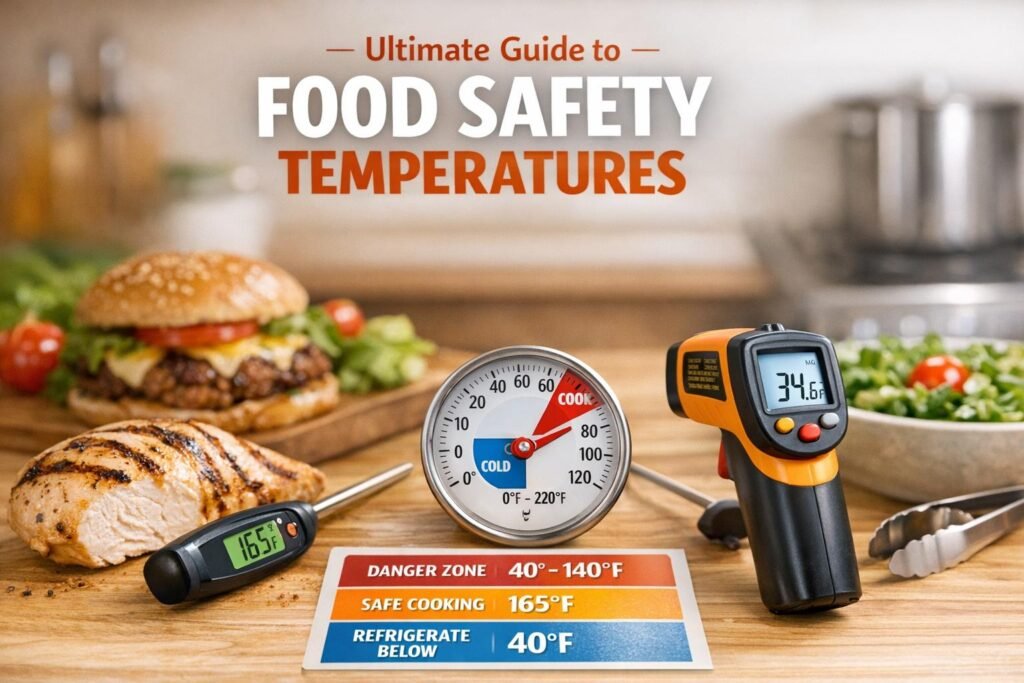
Keeping food at the right temperature is the key to preventing foodborne illnesses. Harmful bacteria like Salmonella and E. coli thrive between 40°F and 140°F, known as the "Temperature Danger Zone." Within this range, bacteria can double in just 20 minutes, making proper storage, cooking, and reheating essential to food safety.
Here’s what you need to know:
- Storage: Refrigerate at 40°F or below and freeze at 0°F or below. Use a thermometer to ensure accuracy.
- Cooking: Use a food thermometer to check internal temperatures. Poultry needs 165°F, ground meats 160°F, and seafood 145°F.
- Reheating: Heat leftovers to 165°F to kill bacteria.
- Cooling: Cool cooked food from 135°F to 70°F within 2 hours, and then to 41°F or below within 4 hours.
- Thawing: Thaw in the fridge, in cold water (changed every 30 minutes), or in the microwave – never on the counter.
Food safety is all about temperature control. Use these tips to protect yourself and your loved ones from foodborne illnesses.
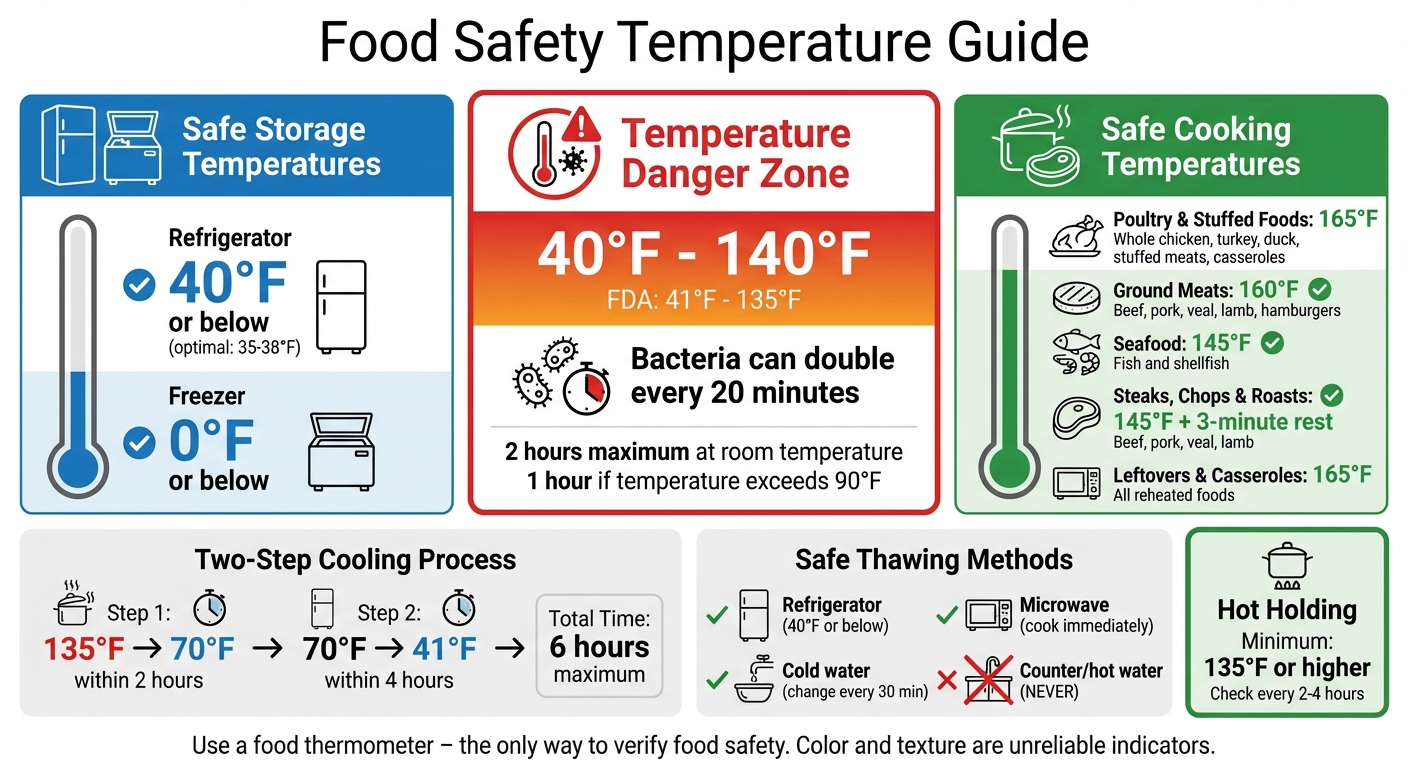
Food Safety Temperature Guide: Storage, Cooking, and Danger Zone Chart
Food Safety for Beginners | Internal Temperatures, Thermometers & How Not to Get Anyone Sick
sbb-itb-663e316
The Temperature Danger Zone Explained
The Temperature Danger Zone refers to the temperature range where bacteria responsible for foodborne illnesses multiply the fastest. For consumers, this range is typically defined as 40°F to 140°F. However, the FDA‘s retail and food service codes set it slightly narrower at 41°F to 135°F. No matter the definition, keeping perishable foods out of this range is critical.
Within this range, harmful bacteria like Salmonella, E. coli O157:H7, and Campylobacter can grow rapidly. According to the USDA Meat and Poultry Hotline:
Bacteria grow most rapidly in the range of temperatures between 40 ° and 140 °F, doubling in number in as little as 20 minutes.
The real danger lies in the fact that some bacteria can produce heat-resistant toxins while in the danger zone. These toxins may persist even if the food is later cooked or reheated to high temperatures.
Perishable items such as cooked meats, dairy products, grains, and fruits should not stay in the danger zone for more than 2 hours – or just 1 hour if the surrounding temperature exceeds 90°F. After these time limits, the food should be discarded, even if it looks or smells fine, because harmful bacteria are invisible.
To stay safe, set your refrigerator to 40°F or below and your freezer to 0°F. Use an appliance thermometer to confirm these settings. Up next, explore how to properly store your food to maintain its safety.
Safe Storage Temperatures
Keeping your food at the right temperature is key to ensuring its safety. According to the USDA and FDA, your refrigerator should stay at 40°F or below, while your freezer needs to be at 0°F or below to prevent foodborne illnesses.
For optimal refrigeration, aim for a temperature between 35°F and 38°F, with 37°F being the sweet spot. The USDA Food Safety and Inspection Service emphasizes:
A refrigerator set at 40 °F or below will protect most foods.
Let’s break down the specifics for refrigerators and freezers.
Refrigerator Temperatures
To make sure your refrigerator is doing its job, use a standalone thermometer to check its temperature. Place it in the warmest spot – usually the door or the upper back shelf – for the most accurate reading. If you adjust the settings, give it 24 hours to stabilize before taking another reading.
Avoid putting perishable items like eggs in the door, where temperatures can fluctuate more. Instead, keep them in their original carton on a shelf. Don’t overcrowd your fridge – leave about 20% of the space free so cold air can circulate effectively. Regular maintenance is also important: clean the condenser coils and check that the door seals (gaskets) are tight.
Freezer Temperatures
Set your freezer to 0°F or lower to keep harmful microbes like bacteria, yeasts, and molds inactive. While food can stay safe indefinitely at this temperature, its quality – such as flavor, texture, and color – might decline over time. Consistent freezing temperatures also help preserve nutrients and prevent large ice crystals from forming, which can damage the structure of the food.
In the event of a power outage, a full freezer can keep food safe for about 48 hours if the door stays closed. A half-full freezer, on the other hand, will only hold its temperature for around 24 hours. If your freezer isn’t full, grouping items together can help retain the cold. Lastly, cool hot food to around 70°F before freezing it to avoid raising the temperature inside the freezer.
Safe Cooking Temperatures by Food Type
Cooking food to the right temperature is essential for killing harmful bacteria. The best way to ensure food is safely cooked? Use a food thermometer. As the CDC emphasizes:
"The only way to tell if food is safely cooked is to use a food thermometer. You can’t tell if food is safely cooked by checking its color and texture." (CDC)
Here’s a breakdown of the safe cooking temperatures for various foods.
Poultry and Stuffed Foods (165°F)
Poultry and stuffed foods need to hit an internal temperature of 165°F. This includes stuffed pasta, meats, or casseroles containing poultry. For whole birds, check three key spots with your thermometer: the innermost part of the thigh, the innermost part of the wing, and the thickest part of the breast, steering clear of the bone. If you’re cooking stuffing inside the bird, test the stuffing’s center separately to confirm it also reaches 165°F.
Ground Meats (160°F) and Seafood (145°F)
Ground meats like beef, pork, veal, and lamb should be cooked to 160°F. The grinding process spreads bacteria throughout the meat, making this higher temperature critical. For thin items like burgers, insert the thermometer sideways to ensure it reaches the center.
Seafood, including fish and shellfish, is safe at 145°F. For fish, look for flesh that’s opaque and flakes easily with a fork.
Steaks, Chops, and Roasts (145°F)
Whole cuts of beef, pork, veal, and lamb are safe to eat at 145°F, but they need a 3-minute rest after coming off the heat. This resting period lets the temperature even out and ensures the innermost parts are fully cooked. For an accurate reading, insert the thermometer into the thickest part of the meat, avoiding any bones or large pockets of fat.
Leftovers, Casseroles, and Ready-to-Eat Foods (165°F)
Reheat leftovers, casseroles, and ready-to-eat foods to 165°F to eliminate any bacteria that may have formed during storage. An exception is precooked ham from USDA-inspected plants, which only needs to reach 140°F. For egg-based dishes like frittatas or quiches, aim for 160°F and check in several spots to account for uneven cooking.
Next, dive into tips for cooling and reheating food safely to round out your food safety routine.
Cooling and Reheating Food Safely
To keep food safe and avoid bacterial growth, proper cooling and reheating are just as important as cooking to the right temperature. In fact, improper cooling is a leading cause of foodborne illnesses, and research highlights that many establishments struggle to follow correct cooling procedures.
Two-Step Cooling Process
The two-step cooling process is designed to move food quickly through the Temperature Danger Zone (70°F to 135°F), where bacteria multiply rapidly. The goal is to cool food from 135°F to 70°F within 2 hours, and then from 70°F to 41°F or below within an additional 4 hours – staying within a total of 6 hours.
To speed up cooling, try these methods:
- Divide large portions into shallow containers (no deeper than 3 inches).
- Use an ice-water bath and stir frequently for items like soups.
- Cut large pieces of food into smaller portions for quicker cooling.
If food doesn’t cool to 70°F within the first 2 hours, reheat it to 165°F and start the cooling process again. These techniques work hand-in-hand with proper cooking practices to ensure food safety.
Rapid Reheating Requirements
When reheating leftovers, always bring them to 165°F to kill any bacteria that may have developed during storage. For items like sauces, soups, and gravies, bring them to a rolling boil.
Here are a few reheating tips:
- Microwave: Cover the food, stir or rotate it for even heating, and let it stand for 2 minutes before serving.
- Stovetop: Use low to medium heat, stirring often, to ensure the food reaches 165°F evenly.
Following these steps ensures that reheated food is safe to eat and free of harmful bacteria.
Thawing and Hot Holding Practices
Safe Thawing Techniques
Thawing food safely is all about avoiding the Temperature Danger Zone – the range where bacteria can double every 20 minutes. That’s why you should never thaw perishable foods on the counter or in hot water. These methods can cause the outer layers to reach unsafe temperatures while the center remains frozen.
The refrigerator is your best bet for safe thawing. It keeps food at a steady 40°F or below, drastically reducing the risk of bacteria growth. For example, if you’re thawing a turkey, plan on about 24 hours per 5 pounds. Once thawed, ground meat and poultry are safe for 1 to 2 days, while steaks and chops can last 3 to 5 days in the fridge.
Need to thaw food faster? Try the cold water method. Place the food in a leak-proof bag and submerge it in cold tap water, changing the water every 30 minutes to keep it cold. Small cuts of meat, like 1-pound packages, can thaw in under an hour. Just remember to cook the food immediately after thawing.
Microwave thawing is another quick option, but it can create uneven hot spots, so cooking right after is a must. For an even simpler approach, you can cook food directly from frozen – just expect it to take about 50% longer than usual.
Once your food is thawed and cooked, the next step is keeping it safe during serving.
Hot Holding Guidelines
To keep food safe after cooking, maintain a temperature of 135°F or higher during service. Tools like steam tables or warming cabinets are designed to hold food at the right temperature, not to cook or reheat it. Always ensure food is cooked to the proper internal temperature before placing it in hot holding equipment.
Use a food thermometer to check temperatures every 2 to 4 hours. Stir foods regularly and keep them covered to distribute heat evenly and maintain the required temperature above 135°F. If food falls below 135°F for more than four hours, it’s no longer safe to serve and should be discarded. Also, avoid mixing freshly prepared food with food that’s already being held for service – it’s a recipe for contamination.
Tools for Temperature Monitoring
Types of Thermometers
For home cooks, digital thermometers are a popular choice. Fast-response thermocouples, for example, can deliver readings in just 2–5 seconds, while thermistors, which take about 10 seconds, are versatile enough for both thick and thin cuts of food.
If you prefer to monitor food without opening the oven, oven-cord thermometers are a great option. These come with a probe connected to a base unit outside the oven. For even more convenience, wireless or smart thermometers send live updates directly to your phone via Bluetooth or Wi-Fi. While these models are pricier than traditional options, they add a layer of convenience that many find worthwhile.
For a budget-friendly alternative, dial thermometers with bimetallic coils are worth considering. Instant-read versions provide results in 15–20 seconds but require an insertion depth of 2 to 2.5 inches, making them less effective for thinner foods. On the other hand, oven-safe dial thermometers can stay in larger roasts throughout cooking, though they take 1–2 minutes to give a reading.
Of course, having the right thermometer is only half the battle – knowing how to use it effectively is equally important.
Using Food Thermometers Correctly
To get an accurate reading, place the thermometer in the thickest part of the food, avoiding contact with bone, fat, or gristle. For thinner items, like hamburger patties, insert the probe from the side to ensure it reaches the center. Alarmingly, a USDA study revealed that 21% of people rely on visual cues like color or grill marks instead of a thermometer – an unreliable and potentially unsafe practice.
"The only way to tell if food is safely cooked is to use a food thermometer. You can’t tell if food is safely cooked by checking its color and texture." – CDC
To maintain accuracy, regularly test your thermometer. Use the ice water method – it should read 32°F after being submerged in ice water for 30 seconds – or the boiling water method, in which it should reach 212°F at sea level. Always wash the probe with hot, soapy water after each use to prevent cross-contamination. When used correctly, most thermometers are accurate within 2 to 4°F.
Conclusion
Keeping food at the right temperatures is one of the most effective ways to prevent foodborne illnesses. In the U.S. alone, these illnesses affect 48 million people annually, leading to 128,000 hospitalizations and 3,000 deaths. These numbers highlight the importance of sticking to safe temperature practices in your kitchen.
Experts at the USDA emphasize that proper temperature control stops bacteria from multiplying and prevents the formation of harmful toxins. And the most reliable tool to ensure food safety? A food thermometer. It’s the only way to confirm that meat, poultry, seafood, and egg dishes have reached the correct internal temperatures. Combine this with proper storage – keeping your refrigerator at 40°F or below and your freezer at 0°F or below – and you’ve got a strong defense against bacterial growth.
Food safety doesn’t stop with cooking. Storing leftovers promptly, reheating thoroughly, and cooling food quickly are just as important. For example, refrigerate food within two hours (or one hour if the temperature is over 90°F) and use shallow containers to speed up cooling. These small yet consistent habits can make a big difference, especially for individuals who are more vulnerable, such as young children, pregnant women, older adults, and those with weakened immune systems.
Managing food temperatures isn’t complicated, but it’s absolutely essential. By making these practices a regular part of your kitchen routine, you can serve meals with confidence, knowing you’re protecting yourself and your loved ones.
For more tips, practical advice, and delicious recipes, check out Comfy Kitchen at https://comfykitchen.com.
FAQs
What is the Temperature Danger Zone, and why should it be avoided?
The Temperature Danger Zone is the range between 40°F and 140°F, where bacteria can multiply quickly, turning food into a potential health hazard. Staying out of this zone is crucial to prevent foodborne illnesses.
To keep your food safe, make sure to refrigerate perishable items without delay, cook foods to their recommended internal temperatures, and avoid leaving cooked dishes sitting out at room temperature for too long. Managing food temperatures properly is an easy yet essential step to ensure your meals are safe to eat.
What are the safe internal cooking temperatures for meats and poultry?
To keep your meals safe and free from harmful bacteria, it’s essential to cook meats and poultry to the proper internal temperatures. A food thermometer is your best tool for ensuring accuracy:
- Beef, veal, lamb, goat, or bison (whole cuts): Cook to 145°F and let it rest for 3 minutes.
- Ground meats and sausages: Cook to 160°F.
- Pork (chops, roasts, steaks): Cook to 145°F and allow a 3-minute rest.
- Poultry (whole or ground): Cook to 165°F.
By following these guidelines, you can enjoy meals that are both safe and flavorful.
What is the best way to make sure my refrigerator is at the right temperature?
To make sure your refrigerator is running at the right temperature, use a refrigerator thermometer. Place it inside and adjust the thermostat until the thermometer reads 40°F or lower. Regularly checking the temperature is key to keeping your food fresh and safe. Maintaining this temperature or below helps stop harmful bacteria from growing, which can spoil your food.